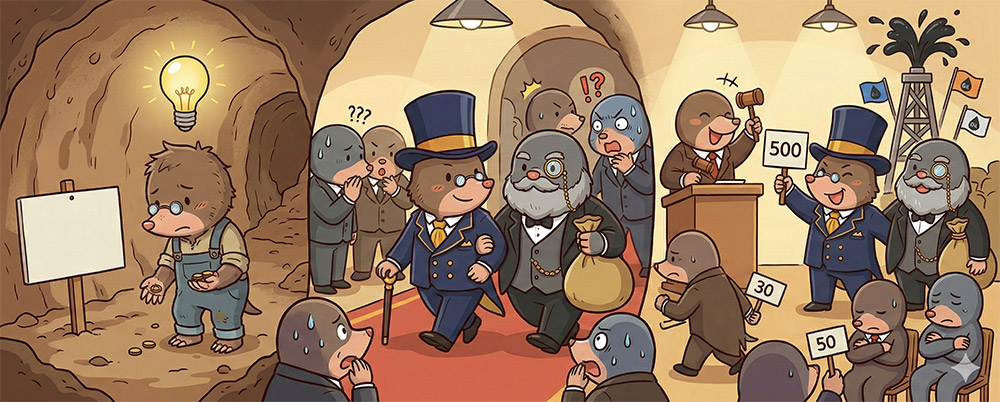
The world often says, "Money makes money."
But is that really true? A 23-year-old young man, lacking both capital and connections, defeated giant corporations with nothing but an 'idea' and laid the foundation for an oil empire.
This is the story of the global oil tycoon, Jean Paul Getty.
October 1915, Oklahoma, USA. A massive wall stood before young Paul Getty.
This was because he had to compete with prominent oil giants for the rights to develop oil fields. As a fledgling, he lacked the funds to withstand the massive onslaught from large corporations. Most people would have turned away, thinking, "Let's give up this time and try again next time." But Paul Getty was different. He decided to target 'perception' rather than 'money.' A modern-day 'empty castle stratagem'On the day of the auction, Paul Getty borrowed a top-of-the-line suit and appeared with the most influential banker of the time.
A relaxed smile and a confident gait.
By bringing along a major banker as an 'advisor,' he instilled the illusion that he was backed by immense financial power.
The competitors began to stir. Fear instantly gripped the bidding hall with the thought, "The son of a chaebol has even brought a major banker; isn't the game already over?" Paul Getty did not utter a single word of bluff.
He merely 'did it' to make the opponent lose their will to fight.
This was a modern reinterpretation of the 'siege stratagem' in which Zhuge Liang threw open the city gates to defeat the enemy, and it was Paul Getty's 'empty city strategy.'
The result was astonishing.
Strong competitors abandoned their bids one by one and left, and eventually, Paul Getty succeeded in winning the oil field bid for a mere $500.
Four months later, high-quality crude oil poured out from there.
He sold this oil field for $40,000, leaving a net profit of over $30,000, and this capital later became the cornerstone of the 'Getty Empire,' which comprised 40 companies.
Ideas Precede Capital More important than the saying "Time is money" is the fact that "ideas are the guide to making money."
More often than not, things get stuck not because there is no money, but because there is no 'perspective' to solve the problem.
Business is Ultimately a 'Psychological War' What is more important than objective figures is the 'frame'—how the other party perceives you.
Depending on how you package and convey the value you possess, the value of $500 can jump to tens of thousands of dollars.
Prepared Guts Seize Opportunity If Paul Getty had merely put on a show while trembling inside, veteran businessmen would have noticed immediately.
Because he had confidence in his analysis (the value of genetics), that bold performance was able to shine.
In conclusion, success belongs not to those who have the most, but to those who set the game most wisely.
Does the problem facing you right now seem too big? If so, recall the 'Empty City Strategy.'
Sometimes, the wisdom of shaking the opponent's mindset will lead you to victory rather than a head-on confrontation.