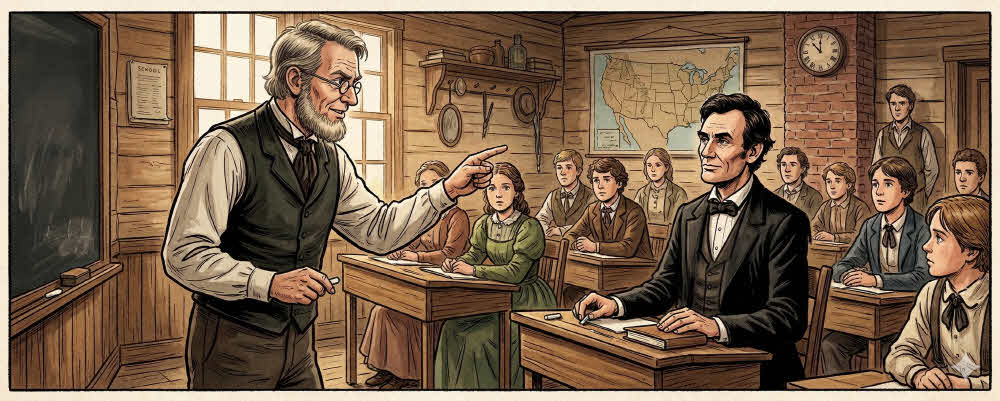
In every era, there is bound to be at least one person like that. They are the ones who set traps to put others in a difficult position or to show off their knowledge.
When Lincoln was still a student, a teacher who looked at his extraordinary talent with eyes tinged with envy and jealousy was one such person.
One day during class, the teacher smiled at Lincoln with a peculiar smile and asked. "Lincoln, would you like one difficult question, or two easy ones?"
Although it took the form of a question, it was actually a trap with no choice.
Choosing the easy one would make him look like a coward, while choosing the difficult one would be the perfect situation to humiliate him.
Lincoln answered without hesitation. "Teacher, I will test my skills with one difficult question."
As if he had been waiting for this moment, the teacher threw out a decisive question. It was a variation of the 'chicken and the egg,' one of the oldest dilemmas in human history. "Good. Then answer me. How did the egg come into the world?" Lincoln answered without a moment's hesitation. "It is because a hen laid it." Then, as if he had seized the advantage, the teacher pressed on immediately. "Then where on earth did the chicken come from?" This question was, in effect, a trap designed to drag you into an endless cycle. It was an infinite loop where if you answered 'chicken,' they asked 'egg,' and if you answered 'egg,' they asked 'chicken' again.
However, Lincoln delivers a surprising twist here.
"Sir, that was the 'second' question just now.
We often encounter situations in life similar to what Lincoln faced.
Pressure questions from a boss at work, or criticisms that are illogical and contradictory.
The response Lincoln showed was not simply nitpicking. He used the 'preconditions for conversation' itself as a shield.
The condition the teacher set was 'one difficult question.
The teacher tried to fluster Lincoln with the content of the question (the origin of eggs), but he had forgotten the constraint of "only one"—the rule he himself had set.
Lincoln accurately saw through the rule set by the other party, caught the moment they violated it, and ended the conversation.
In terms of modern psychology or business, this can be described as a "frame shift."
Instead of being trapped within the frame of the question designed by the other party, he regained the initiative by pointing out the very "structure" of the exchange of questions.
Koreans have a unique culture of 'Nunchi.'
It is a sense of grasping the other person's intentions. Lincoln's handling of the situation can be considered the pinnacle of this culture of reading the room.
What would have happened if Lincoln had seriously brought up creationism or evolution and argued with the teacher here?
It likely would have been a pointless fight throughout the class, and the teacher would have glared at Lincoln, trying to find a flaw in him at all costs.
However, Lincoln resolved the situation by mixing 'humor' and 'composure.'
This aligns with the sophisticated conversational style of 'saving face while still speaking one's mind', which is particularly important in Korean society.
It is a technique of elegantly escaping a predicament without blatantly ignoring the other person.
First, remember the 'conditions' set by the other person until the very end. You can avoid many pitfalls simply by confirming what the agreed-upon premise was at the start of the conversation.
Second, do not fall into the swamp of 'circular reasoning.' Rather than struggling to answer questions where cause and effect follow one another, it is wiser to point out the contradictions inherent in the question itself.
Third, humor is the most powerful weapon. The power to smoothly neutralize sharp exchanges lies not in eloquent speech, but in the composure to view the situation objectively. [It appears.] Even after becoming president, Lincoln deflected attacks from numerous political rivals with such ingenious answers and metaphors. Just as he said, "If I were given six hours to chop down a tree, I would first spend four hours sharpening the axe," shouldn't we also first sharpen the 'edge of wisdom' that penetrates the essence of the conversation, rather than immediately answering someone's sharp question? The answer may lie not in the content of the question, but in the 'way' the other person asks it.