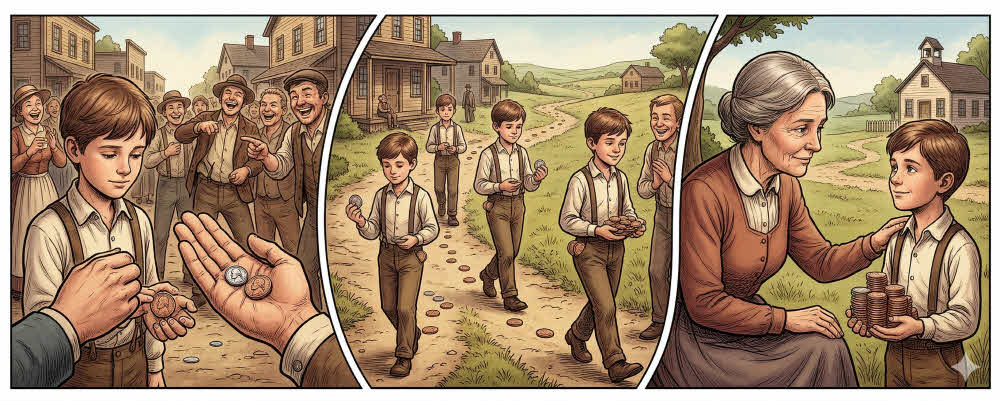
In a quiet village, there was a boy who was particularly introverted and quiet.
The villagers used to think that the boy was a bit lacking.
Whenever they were bored, they would stop the boy and play mischievous pranks on him.
Placing a gleaming 10-cent coin in one hand and a larger 5-cent coin in the other, they would say.
"Boy, take whichever one you want."
The boy would pretend to think for a moment, then, as always, without hesitation, pick up the larger 5-cent coin.
The villagers burst into laughter. "What a fool! The 10-cent coin is much more expensive, you know."
Mockery and jokes poured down from behind the boy, but he simply put the 5-cent coin in his pocket silently and set off on his way.
There was a lady who watched this scene, which repeated itself day after day, with pity.
She called the boy aside and asked him kindly, "My boy, do you really not know that 10 cents is worth more than 5 cents?"
It was then. The boy, who always kept his head down, lifted his head, looked at the lady with clear eyes, and smiled. And he whispered quietly.
"Madam, I know that well. But the moment I pick up ten cents, their game will end right there.
Then I will never get even five cents again."
Hidden within this short answer was immense wisdom that would astound the world.
This boy was none other than William Harrison, who would later become the 9th President of the United States.
We live in a truly busy world. We have grown up being taught that we must be one step ahead of others, and that taking a loss is tantamount to failure. In a society where the word "cunning" sometimes sounds like a compliment, Harrison's "5-cent philosophy" poses a weighty question to us.
The fine line between 'smartness' and 'wisdom'Securing the 10 cents right in front of you is 'smartness.'
It yields short-term results and is efficient. However, choosing 5 cents to secure tomorrow is 'wisdom.'
Wisdom is the power to set aside immediate pride and keep the possibility of a more distant future open.
Humility that creates lasting relationshipsIn Korean sentiment, there is a concept called 'Deok.'
Humbling yourself a little and making the other person feel proud—that can ultimately become the best technique for winning them over.The villagers who mocked Harrison were, in fact, 'loyal customers' who brought him 5 cents in profit every day.
The Aesthetics of Late Bloomer Just as the saying goes that a great vessel is made slowly, young Harrison cultivated inner strength while enduring immediate ridicule.
A clear self-conviction about why he was making this choice, rather than how others viewed him, led him to the position of president.
Whether in the business world or in human relationships, we always stand at a crossroads of choice.
There are moments when we feel satisfied only when we take 100% for ourselves. However, whenever that happens, I hope you will remember Harrison's five cents.
Yield the sense of victory to the other person. When it appears you are taking a slight loss, the other person opens their heart and comes back to you.
Believe in the power of reputation. More opportunities eventually gather around 'people who are easygoing but deep-hearted' rather than 'calculating people.'
Look at things with a long-term perspective. Do not forget that the five cents you can earn a hundred times are much greater than the ten cents you gain today.
By choosing the five cents, William Harrison did not simply make money; he cultivated the composure to contemplate the world and the insight to read human psychology.
While others pointed fingers and called him a "fool," he was building his own massive castle inside.
Are you currently losing sleep over the thought that you are being ignored or taking a loss?
Perhaps, like the boy who will one day become president, you are currently collecting the wisest five cents.
Do not be impatient just because you do not see the ten cents right now.
The true winner is not the one who laughs last, but the one who designs the environment that makes others laugh.