As we go through life, there are times when we fall into deep contemplation, wondering, "I did my best, so why is the result like this?"
Or, "I told the truth, so why is the other person angry?"
If you are someone whose skills are perfect but who fails to receive recognition because something feels 2% lacking,
the story of 'A One-Eyed King and Three Painters' might become a turning point in your life.
Once upon a time, in a certain country, there was a king who lost an eye and a leg on the battlefield.
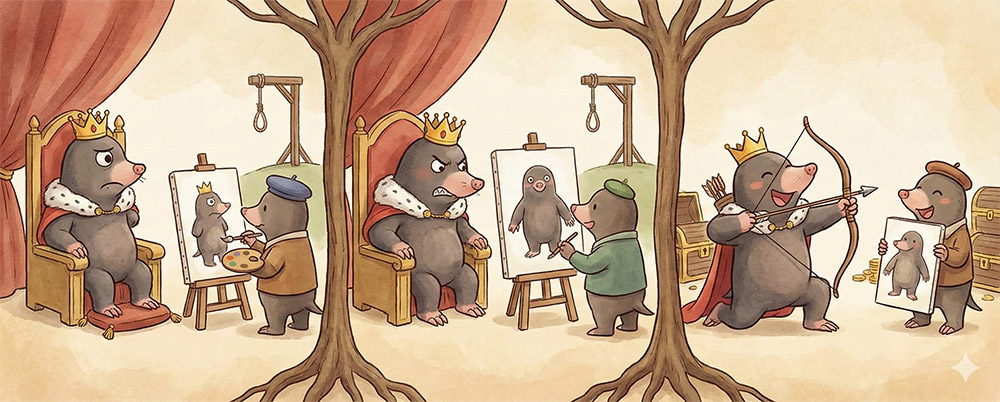
He wanted to leave behind a portrait of himself, so he summoned the greatest painter of the time.
The first painter believed that 'honesty' was the greatest virtue.
He depicted the king's hideous wounds and empty sleeves exactly as they were, very vividly.
Result: Execution.
Lesson: Indifferent realism that disregards the other person's pain can sometimes be poison.
In our society as well, the communication style of digging into others' wounds while saying, "I'm not saying anything wrong," is just like this.
The second painter was terrified by the death of the previous painter.
So, he painted the king in a very healthy and perfect state.
It was the image of a king with two clear eyes and two sturdy legs.
Result: Execution.
Lesson: Excessive flattery that distorts the facts can be perceived as 'mockery' by the other person.
Dressing up only the shell lavishly while ignoring the essence destroys trust.
The last painter pondered deeply.
'How can I maintain the dignity of a king without telling a lie?' Finally, he picked up his brush. The king in the painting he created looked like a brave archer sitting on one knee, with one eye closed, pulling back the bowstring. The result: High praise and a large prize. The secret: It was not about hiding flaws, but designing an 'optimal situation' where flaws are not revealed. This is the 'essence of wisdom' that applies equally to business, human relationships, and marketing in modern society.
No matter how outstanding your skills are, it is difficult to have their value recognized if you do not understand the situation and target audience in which they are used.
You must first consider "what the other person wants to see" rather than "what to draw."
In Korean sentiment, 'Jeong' (affection) and 'Ye' (propriety) are very important.
You need a 'warm honesty' that conveys the facts while protecting the other person's self-esteem.
That is exactly what we commonly call 'sense' and 'wisdom.'
The third painter sublimated the king's disability into natural movements through the 'setting of him being an archer.'
We, too, rather than blaming our weaknesses or business limitations,must find a new frame where they are invisible or can even stand out.
Those who only work hard are likely to become the first painter, and those who only try to look good are likely to become the second painter.
However, successful people become the third painter who reads the situation and finds the optimal answer.