There wasn't a single penny in incentive. There was no foaming-at-the-mouth nagging, nor threats of immediate dismissal.
Yet, there is a factory where production jumped 15% overnight and reclaimed the top spot in the industry within a few months.
What created this miracle was not a grandiose management strategy.
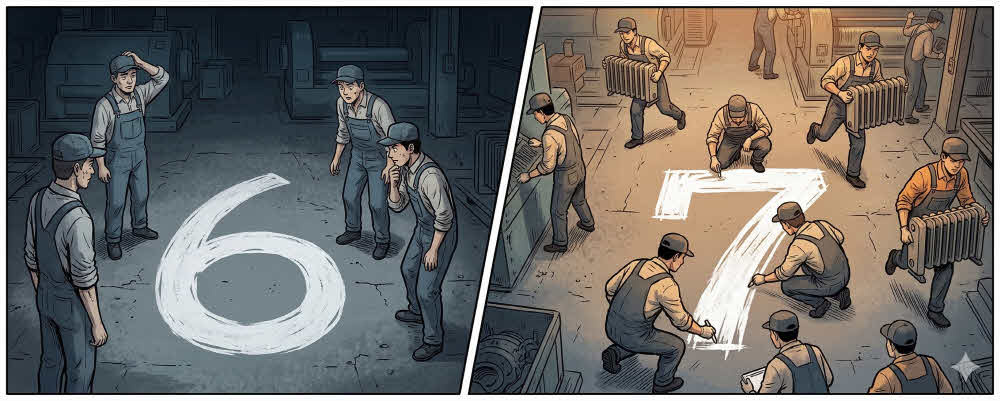
It was simply a number '6' written in large letters with chalk on the factory floor.
How was this possible? We invite you to that magical moment.
The executive most trusted by Andrew Carnegie, the American steel magnate,
Charles Schwab. One day, a factory manager came to him and practically knelt down to plead his case.
"Boss, I really can't take it anymore.I've deployed all the foremen known for their competence, and I've even offered performance bonuses.
I even threatened to fire them if things didn't work out.
But despite all that, the heat just won't circulate in this damn factory chimney. We can't even meet half of our target."
The factory manager was utterly exhausted. It was exactly the same dilemma faced by countless leaders in Korea.
That helplessness hidden behind phrases like 'You can't communicate with the MZ generation' or 'Kids these days have no passion.'
Schwab smiled and said. "Well then, I'll go and see for myself."
As the day shift was drawing to a close, Schwab appeared at the factory.
He approached a worker covered in sweat and grease and asked, "How many heaters did your shift make today?" "We made six (6)."
Schwab said nothing.
Instead, he picked up a piece of chalk that had fallen nearby.
And he wrote the number '6' in large letters right in the middle of the passageway where all the employees passed.
And then, they left the factory without looking back.
When the night shift workers arrived for work, they murmured amongst themselves upon seeing the bizarre number '6' written on the floor.
"What is this? Did someone play a prank?" "The boss came earlier, asked the day shift guys how many they made, and then wrote that down before leaving."
At that moment, something snapped inside the hearts of the night shift employees.
'The day shift guys made 6? Just? What makes us worse than them?'
The stubbornness and pride unique to Koreans had kicked in. That night, the night shift worked with a fire in their eyes, more intense than usual.
The next morning, when the day shift arrived, the '6' on the floor was gone.
In its place, a number '7', scrawled much more vigorously, was shining.
Now the factory had become a giant game board.
As soon as the day shift arrived, they scoffed at the number '7'. "Look at this? The night shift guys are pretty good. We're going for 10 today!"
That evening, a menacing number '10' was written on the floor.
People who, just a few days ago, had been stuck at 4 or 5 and merely watching each other, now began to brainstorm innovations on their own to beat the neighboring team, without anyone telling them to.
It wasn't simply about doing a lot of work.
The employees started putting their heads together to figure out how to assemble faster and where to save time. Eventually, this factory, which had always been at the bottom, became a legend by recording higher productivity than any other factory under Schwab.
Why did beatings and threats of dismissal fail, while the number '6' succeeded?
The instinct of comparison: Humans instinctively dislike falling behind others. This is especially true in places like Korean society, where a strong sense of community and competitiveness prevail.
Respect for Autonomy: The moment you command, "Work!", work becomes 'pain,' but the moment you toss out, "They did six, didn't they?", work becomes a 'game.
Tangible Goals: A single visible number serves as a much more powerful motivator than a vague slogan like "Let's do our best."
If your team is stagnant right now, or if you yourself have fallen into lethargy, take a moment to think. Are you perhaps only giving 'orders' and 'coercing'?
What moves people's hearts is not grandiose rhetoric. Breathing air into that small spark of 'wanting to do better' within the other person's heart—that is the very essence of leadership.