The city center at sunset is always a languid gray.
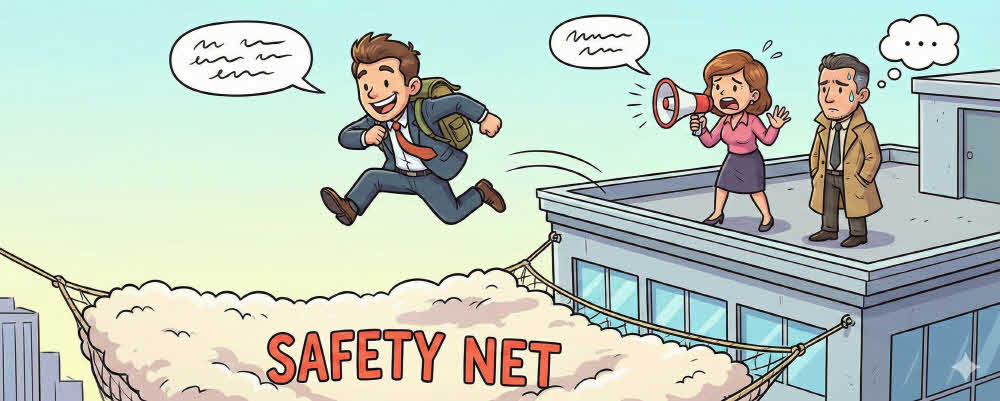
But that day, standing on the railing of a mixed-use building in Gangnam was a man with a face even paler than that gray.
His name was Deputy Manager Kim. He was an ordinary office worker, the kind commonly seen in South Korea, living with tens of thousands of invisible bricks of the name "head of the household" weighing on his shoulders.
Just as he was about to neatly place his shoes at the edge of the railing, the rooftop door burst open and his wife rushed in.
Gasping for breath, the words she cried out were desperate.
“Honey! Please don’t act impulsively! We have such a long way to go; how can you act like this already!”
His voice was filled with sincere worry and determination for the future.
However, upon hearing those words, Deputy Chief Kim's eyes trembled slightly.
And without a single second of hesitation, he threw himself into the void.
Fortunately, he landed on an air mattress that firefighters had set up in advance and survived, but everyone at the scene was puzzled.
Why couldn't his wife's desperate cry have stopped him?
A seasoned negotiation expert watching the situation from the side clicked his tongue, approached the wife, and spoke in a low voice.
“Madam, that wasn't comfort just now... it was a threat bordering on a ‘declaration of war.’
We often substitute encouragement with phrases like “You still have a long way to go” or “You are still young” when someone is feeling discouraged. However, we must consider how these words resonate with the weary souls living in Korean society. The ‘long road’ that flashed through Deputy Manager Kim’s mind was likely something like this: The principal and interest on the apartment mortgage that he would have to pay for another 20 years. The private education expenses and university tuition for children who are merely elementary school students. The helplessness of the possibility that he might not be able to rest even after retirement and would have to look for work as a security guard or deliveryman. To him, his wife’s words did not sound like a comforting "hang in there a little longer," but rather like a life sentence: "You do not even deserve to die yet. You must carry this heavy burden and keep walking for decades to come."
This is precisely the ‘paradox of sincerity’ inherent in Korean society.
We too easily place the value of the future above the pain of the present under the pretext of caring for our loved ones.
“I have to endure it for the sake of the kids.”
“Everyone else lives like this too.”
“There will be a day when we can laugh later.”
These words are not actually communication.
It is a form of emotional oppression that suppresses the other person’s pain under the pretext of ‘future rewards.’
This is also why a negotiation expert described the wife’s words as ‘threats.’
The husband is suffocating and looking for an oxygen mask right now, but the wife is essentially handing him a ‘marathon full course completion certificate’ and encouraging him not to slow down.
What if, at that moment, the wife had said this?
“Honey! Come down! The loan? Tell them to go ahead and pay for it!
Let’s just go down to the countryside and live working part-time at a convenience store. All I need is you by my side!”
Manager Kim might have climbed down from the rooftop railing, grabbed his wife, and sobbed uncontrollably.
Sometimes, words that seem irresponsible become the most responsible comfort in the world. This is because what is needed when the other person is standing on the edge of a cliff is not a ‘blueprint for the distant future,’ but permission that ‘it is okay to put down the burden right now.’