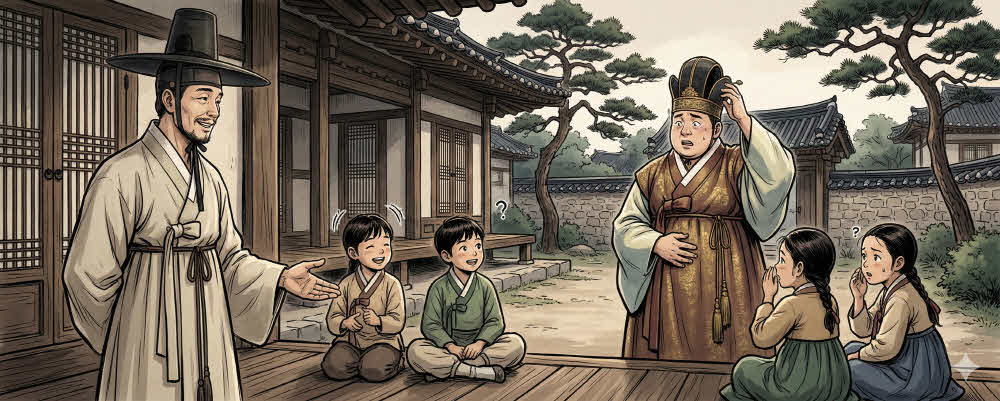
Once upon a time, in a certain village, there lived a scholar who was deeply learned but in dire straits.
Although he was in abject poverty, the sound of his reading was always clear and spirited.
Eventually, when he could no longer make a living, he became a tutor for one of the wealthiest families in the village.
The wealthy man had four children.
The scholar taught the children with all his heart, and following their teacher's profound intentions, the children began to open their eyes and master countless Chinese characters in less than a year.
However, the problem began as the end of the year approached.
The wealthy man, who held the key to the storehouse, became reluctant to pay the promised salary.
He came up with a plan. He intended to take his children to the scholar’s lecture, cause a disturbance to undermine the teacher’s authority, and then make the unreasonable claim that "since you taught nothing, there is no money to give you." The scholar had already read the malice in the rich man’s eyes. He quietly prepared to pack his bags and stood at the podium for the final lecture. Then he asked the children: "Children, do you know what I am going to talk about today?" The children widened their eyes and answered, "We don't know." Then the scholar smiled and said: "If you don't know, think carefully. When you figure it out on your own, then I will teach you." The scholar turned around and left. It was the rich man who was flustered. For the plan to ruin the lecture was thwarted by the scholar's surprise remark.
The next day, the rich man did not give up and resorted to an even more arduous tactic. He had instructed his children in advance.
"If the teacher asks again tomorrow, you must answer that you know everything no matter what!
Then he will press the issue by saying that since there is nothing left to teach, there is no need to pay him."
The following day, the scholar sat across from him again and asked the same question. At this, the rich man shouted defiantly on behalf of the children.
"Our children already know exactly what you are going to say!"
The scholar laughed heartily and replied.
"Since you already know everything, what more is there for me to add?"
He left once again. The rich man was furious.
His attempt to play a trick on the scholar had instead ended up giving him a rest.
Eventually, the rich man played his final move. He had two of the children answer "I know" and the other two answer "I don't know."
His calculation was to silence both sides.
On the third day, the scholar stood before the children again.
As the rich man instructed, two children answered "I know," and the other two answered "I don't know."
The rich man was convinced that now, finally, the scholar would either be forced to continue teaching without a word or would stumble, unable to answer.
However, the words that came out of the scholar's mouth were a single remark that struck the rich man from behind—a truly blindsided blow.
"In that case, it is truly fortunate. Since there are already two children here who know the content, have the two children who know teach the two children who do not."
This short sentence sliced through the rich man's greed with a single stroke. The scholar left the house without a second thought.
The 'power of money' that the rich man tried to wield was powerless against the scholar's 'sword of wisdom'.
The rich man may have realized only then that wisdom reveals its sharp edge to those who despise it and try to use it, making them feel ashamed.
First, learning is not achieved through coercion.
Even if the teacher is ready to teach, if the learner closes the door of their heart or regards the teaching as a means, that knowledge becomes dead. The scholar’s statement, “I will teach you when I know,” suggests that the essence of learning lies in ‘voluntary curiosity.’ Second, wisdom knows how to win without fighting. The scholar did not sit face-to-face with the rich man and shout for his salary or argue. Instead, he made the rich man fall into contradiction within the yoke the rich man had created.
I believe this is precisely the dignity of conduct our elders should possess.
Third, it is the virtuous cycle of sharing.
The saying "Let those who know teach those who do not" remains a very important value in modern society.
Knowledge becomes power when monopolized, but it becomes value only when shared.
However, this story contains a warning that even that sharing must not become a tool of greed.
We live every day negotiating and persuading others.
Sometimes we devise schemes for our own benefit like the rich, and sometimes we find ourselves in unreasonable situations like a scholar.
If you are currently facing a desperate situation, please try to recall the composure of a scholar.
Rather than striving to subjugate the other person, a single word that pierces the essence of the situation is stronger than a hundred words of criticism.
"Let two who know teach two who do not."