One day, the global company Chevron was in a dilemma.
Before entering the new beverage market in Tulsa, Arizona, they wanted to know people's true tastes and consumption habits.
They conducted numerous surveys, but the responses were always predictable. "We eat healthy food and consume rationally."
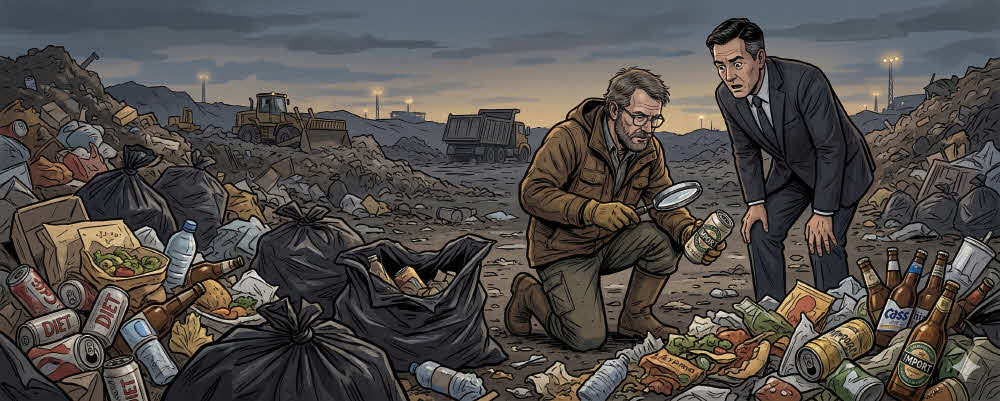
However, Professor William Rathje, the anthropologist Chevron visited, focused on a completely different place.
Instead of a neat conference room, he headed to a massive landfill reeking of foul odors. And a year later, he presented a revolutionary report to the CEO of Chevron.
"Mr. President, the mouth lies, but a trash bag does not."
The data he retrieved from the trash heaps overturned the common sense of the time.
People commonly assume that the high-income class enjoys expensive imported beer.
However, an analysis of the trash bags revealed the exact opposite.
Surprisingly, low-priced beer cans poured out of the trash cans of the high-income class, while large quantities of expensive imported beer bottles were found in the trash cans of the working class.
The 'small luxury' and sense of reward that one gives oneself at the end of a hard day remained intact in the trash cans.
In the survey, the truth that people could not answer due to saving face regarding the question "What kind of beer do you usually drink?" was transparently revealed inside the trash bags.
The trash bags of the middle class were even more interesting.
Unprocessed food ingredients poured out of the bags of this demographic, where many dual-income couples reside.
15% of the total food waste consisted of high-quality food that was either past its expiration date or was perfectly edible.
The trash cans contained a sad portrait of modern people who, amidst their busy lives, go grocery shopping to "eat well and live," but end up throwing it away because they lack the time to actually cook it.
This was a strong signal that 'convenience' is key to targeting the middle-class market.
Finally, traces of 'weight-loss diet soda' and 'freshly squeezed orange juice' were found particularly frequently in the trash of high-income earners.
The cost they were paying was not merely the price of the beverages, but the cost of maintaining 'health' and 'youth.'
Professor Reitz redrew the consumption map of the Tulsa market through this trash analysis, and Chevron formulated strategies based on this 'dirty data' to reap massive profits.
We always try to present only a refined and polished image to others (social media, surveys, conversations).
However, our true lives remain in the trivial habits we carelessly overlook, the actions we take when no one is watching, and the 'traces' we discard at the end.
Wise leaders and businesspeople who lead the world never look only at flashy reports.
They smell the scent of the field and find undiscovered opportunities in what people have discarded.
Real information may be found in the appearance of stacks of boxes in the back alleys of the market rather than in the figures from the National Statistical Office.
The consumer's heart may be in the list of items they added to their shopping carts and then deleted at the last minute, rather than the "Like" button.