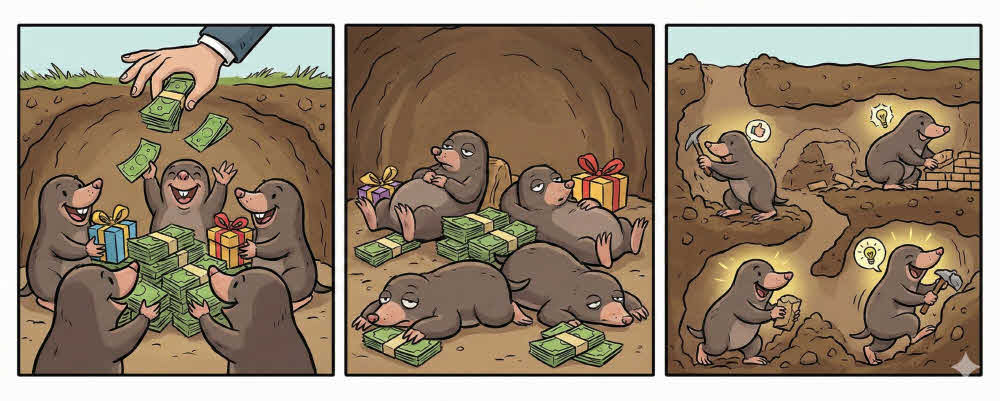
We often say that "money can buy anything," but the reality is often the exact opposite.
An employee given a raise becomes lethargic again three days later, and a child bought an expensive toy throws an even bigger tantrum two days later.
All that comes back to a lover who has poured their heart into it is an indifferent attitude that says, "It is only natural."
Why does the more you give, the more 'useless' the other person becomes?
We explore this harsh truth and solution through the 'motivation formula' revealed by Nobel laureate in economics Daniel Kahneman and behavioral psychologists.
In psychology, there is a concept called the 'cognitive appraisal effect'.
The moment we offer a reward to get someone to do a task, our brain instinctively judges it this way:
"Ah, this work is so boring and worthless that I wouldn't do it without a reward."
Eventually, the 'challenger' who was acting on their own initiative degenerates into a 'mercenary' seeking only rewards.
When the reward is cut off, the engine of motivation immediately comes to a halt.
Just like the wise(?) revenge of the old man who turned 'play' into 'labor' by giving money to children who were causing a disturbance.
The most frequent mistake in Korean workplace culture is 'linear rewards.'
The first bonus is exciting, but the tenth bonus becomes a taken-for-granted right.
This is called the 'Law of Diminishing Marginal Utility.'
On the contrary, external incentives hinder flow.
Programmers who are obsessed with performance bonuses become desperate to increase the number of lines rather than the quality of the code,
and this eventually turns the joy of creation into a greed for numbers.
If you want 'resonance' that makes them move on their own, rather than simply 'breeding' them with money, you must remember the following formula.
Motivation = Expectancy + Instrumentality + Valence
An offer to give you a Rolls-Royce if you sell $100 million is attractive, but the motivation is 0.
This is because the probability of success is 0.
Design step-by-step victories rather than a grandiose vision.
Humans only take action when specific guides and resources are provided to increase a 10% success rate to 50%.
If you work hard but the boss takes the credit, and
rewards are divided equally, no one will do their best.
Transparent and immediate feedback is necessary.
Just as experience points accumulate instantly when you catch a monster in a game,
visualize the 'causal relationship' where your contribution leads to the result.
There is an employee who desperately wants to sleep in for two hours the next morning more than 200,000 won in cash, and
there is a wife who desperately wants a quiet meal with her husband more than a designer handbag.
Read the other person's needs. You must determine whether they want growth, stability,
or dignity. Just as Steve Jobs asked the Pepsi CEO, "Are you going to sell only sugar water?", you must elevate the other person's value to a higher level.
Are you a commanding leader or a colleague who ignites a fire?
True motivation is not an era where superiors bestow upon subordinates.
It is an equal resonance that instills the conviction that the other person can become a 'better being.' Humans are beings who seek meaning. If you give those around you the belief that "your efforts are not in vain, and
you have the ability to change this situation,"
they will become engines that shine on their own.
The best leadership is not making people work for me,
helping them discover the hero within themselves.