In this world, there are many cases where the outward appearance differs from the essence contained within.
Sometimes, a dazzling jewel right before your eyes can become poison, while a desperate will can become a lifeline of salvation to continue the family line.
The Talmud, containing the wisdom of ancient Jews, features a very peculiar and sharp psychological battle surrounding 'inheritance.'
This story is not simply about a 'clever father,' but is also a highly strategic treatise demonstrating how results can be reversed when the premise changes.
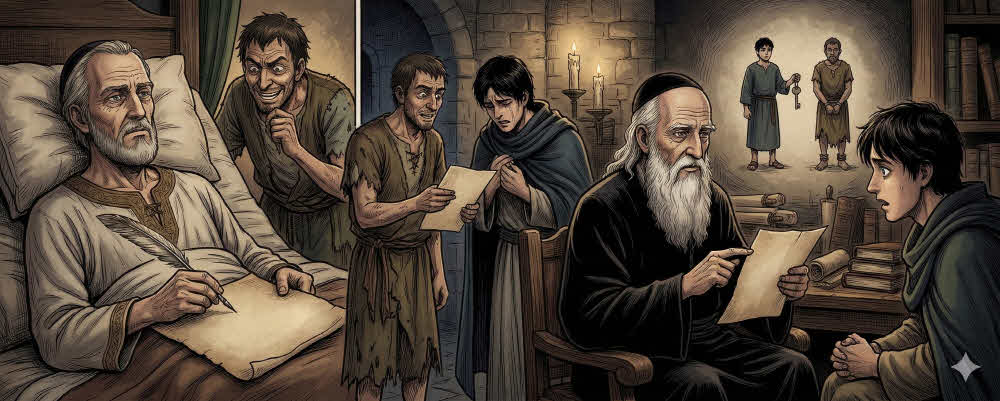
Once upon a time, there was a son who had left to study in a foreign land far from Jerusalem. His father, who was guarding his hometown alone, suddenly fell ill and sensed that he would pass away without ever seeing his son's face again.
The father fell into deep contemplation.
'If I die now, won't this greedy slave snatch my property and run away?
If that happens, my son, who is far away, will not even know of my death and will be left penniless.
The father wrote a will with trembling hands.
And its contents were so unconventional that anyone would raise an eyebrow.
"All my property is bequeathed to the slave.
However, I grant my son the right to possess just one thing—the right to have only one item of his choosing.
The slave cheered with joy.
As soon as his master died, far from claiming the property, he rushed to his son in Jerusalem to announce the joyful news and proceed with the official inheritance procedures.
When the son saw the will, it felt as if the sky had fallen. A sense of betrayal and sorrow at being abandoned by the father he had trusted his entire life overwhelmed him.
After the funeral, the son went to see a wise rabbi to plead his case.
"How could you do this, Father? You allow only one thing to a son who has lived faithfully his whole life, yet give everything to a slave."
The rabbi laughed heartily and urged him to read the will again.
And he awakened him to the truth hidden within that 'strange clue' his father had designed.
"Your father was truly a wise man. If he had left you his property, the slave would have snatched it up and run away before he could even tell you.
But because he promised to give the property to the slave, he had no choice but to come find you.
Have you forgotten that you have the right to choose 'only one'? Remember the law that all a slave possesses belongs to the master."
The son slapped his knee. The 'only one thing' the son chose was none other than 'that slave'.
The moment the son came to possess the slave, all the property inherited by the slave naturally became the son's.
The property the slave had cherished like a precious jewel was, in the end, preserved intact for the sake of his son.
The rights the slave possessed were, in fact, a hollow shell.
He believed he possessed immense wealth, but those rights were a temporary power valid only under the premise that 'his son would not choose him.'
The Jewish father gave the slave very sweet bread, but in reality, that bread was nothing more than bait that his son could swallow in one bite at any time.This is not a simple trick, but a highly intelligent design that accurately grasps the direction of essential ownership.
Contract terms that appear to offer tremendous benefits on the surface can be instantly neutralized by a single key toxic clause.
There are also those who lure the other party with flashy rhetoric, but leave them feeling disillusioned by changing the 'preconditions' at the crucial moment.
This Jewish stratagem ultimately delivers a stern warning: "When you think you have it all, check whose palm you are in."
In our culture, there are expressions such as 'putting yourself in someone else's shoes' and 'turning misfortune into fortune.'
The father did not leave his son a 'result' in the form of wealth, but rather a legacy of 'wisdom' and 'safety nets' to navigate through crises.
The son's final act of freeing the slave, thereby completing this legacy, also demonstrates the conclusion of the Korean concept of 'Deok (virtue),' which sublimates the father's wisdom into compassion.
Ultimately, the numerous temptations and trials we face on the long journey of life may be nothing more than the 'empty shell' that this slave possessed.
Only when we do not waver over appearances but possess the eyes to read the underlying principles and currents can we reclaim our lost legacy and become the true masters.
Wisdom is not about grasping what is visible, but the power to control invisible connections.
Do you believe that what you are holding right now is everything?
Or are you looking at the bigger picture hidden behind it?