We always live as if we are being chased by something.
More traffic, higher sales, faster success. Just like people sprinting toward an invisible finish line.
Strangely enough, the more we run like that, the more out of breath we get, yet the destination feels like it is getting further and further away.
The story I am going to tell you today is about an old gentleman who walked in the opposite direction.
Perhaps by the time this story ends, a tiny crack might form in your heart.
And through that crack, a thought completely different from before might seep in.
That day, we were lost.
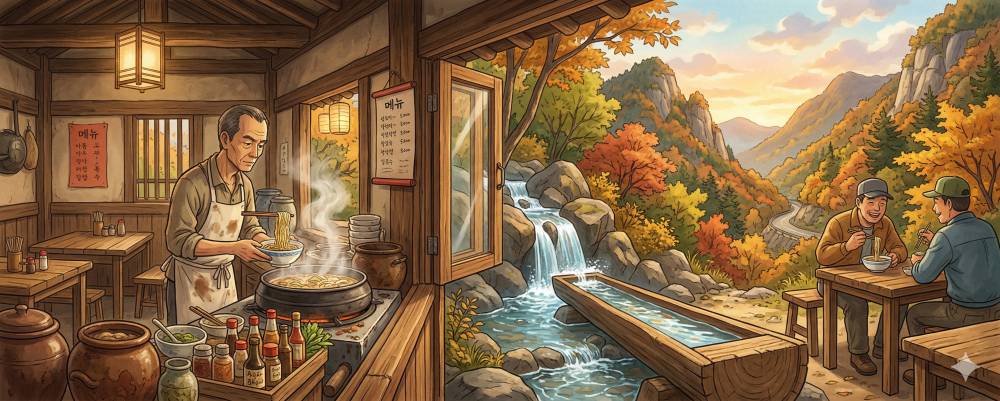
On a mountain path where even the GPS had given up, hunger was gradually turning into irritation. Then, just as I was about to give up, an old restaurant caught my eye. It was a small shop with a worn sign swaying in the wind, only four tables, and the owner doing all the cooking and serving. Strangely enough, despite its shabby appearance, there was an atmosphere that made it difficult to strike up a conversation. It was the kind of space where you felt compelled to lower your voice, as if you had entered an ancient temple. The owner wore a grease-stained apron, but his eyes did not look worn at all. They were the eyes of someone who had traversed the ages, the eyes of someone who had seen much yet remained silent. On the red paper taped to the wall, there were only four items on the menu: Spicy Noodles, Pork Offal Noodles, Beef Noodles, and Vegetarian Noodles. As my friend asked about the ingredients while choosing from the menu, the owner spoke in a low voice without even lifting his head.
“Just tell me if you like spicy food. I’ll take care of the rest.”Strangely, those words did not sound unfriendly.
Rather, it sounded like a matter of course, just as waves do not ask a sailor for direction, or a craftsman does not ask the ingredients for permission.
Watching him cook, it felt less like cooking and more like a ritual.
He picked up the spice jars without looking, scooping out, sprinkling, and pouring using only the sense of touch in his fingertips.
Like an old herbalist picking up medicinal herbs without looking at a scale, or like a pianist playing without a score, his hands moved without hesitation.
The fire repeatedly flared up and fizzed out, and a short, storm-like sound came from the pot before quickly subsiding.
And just two minutes later. Two bowls of noodles were placed before us.
The moment we took a bite, we looked at each other.
It was a flavor that stood precisely on the boundary line where it would have been greasy if it were stronger, and bland if it were weaker. The spiciness struck like a knife and vanished like mist, while the aroma opened slowly like multiple layers of curtains until, at a certain moment, it had become a single landscape.
It felt less like food and more like reading a short story inside my mouth.
I couldn't help but ask.
With skills like this, you could make a fortune in the city, so why do you run a business in the mountains like this?
He paused his knife for a moment and looked at us. And he spoke very slowly.
“Young man, there is no limit to how much money you can earn, but there is a limit to water.”He said that his noodles were made exclusively with spring water from the foot of the mountain.
Exactly two buckets a day. He said that if he used more water, the spring would become cloudy and the taste would change.That is why he said he would not accept more customers, even if he could.
“Spring water needs to rest to become clear. People need to rest for their touch to return. The soil needs to rest for its fragrance to deepen. I am not selling noodles. I am selling this water, this air, this time, and this space together. If you exceed this limit, you may earn more money, but the taste will die.”
The moment I heard those words, a strange thought crossed my mind.
We always live dreaming of infinity, but this old man lived with his limits clearly defined.
We strive to have more, but this old man was striving not to exceed them.
We try to increase our speed, while he was trying to maintain it.
It was as if we were constantly pressing the accelerator, while he looked like someone who knew exactly when to step on the brake.
Since that day, a friend came to mind.
He was a friend who worked in e-commerce; he would stay up all night whenever platform algorithms changed, pour money into advertising to buy traffic, and his face would freeze as if he were dead whenever the numbers dropped.
He saw customers as graphs before seeing them as people, and products as click-through rates before seeing them as goods.
So I told him the story about that noodle shop.
Don't view customers merely as numbers, but as a person's life. Don't try to sell products, but think about ways to make their day a little better. Don't chase traffic,
make people come to you on their own. Don't try to catch the wind, but build a forest where the wind lingers.
He stopped advertising and instead started making products again.
And he wrote thank-you letters by hand to each and every customer.
At first, sales dropped.
Just like how a river dries up for a while when you change the course.
But as time passed, something strange happened.
Customers began bringing in other customers on their own.
The people gathered through advertising remained as numbers, but the people gathered with sincerity returned as stories.That was when I realized.
Money runs away if you chase it, but follows if you create a reason. The more you try to catch the result, the further it gets, and the more you create a cause, the closer it gets.
A farmer does not cultivate fruit.
A farmer merely touches the soil.
Yet people keep trying to grasp only the fruit.
I lived like someone looking only at the height of the waves instead of the sea.
Then one day, I saw a vine growing in the yard.
The vine does not try to grow fast.
Nor does it stand still.
It simply grows only as much as it can today.
When it rains, it climbs up the rain; when the wind blows, it winds around to avoid the wind.
If a wall appears, it climbs the wall; if a pillar appears, it wraps around the pillar.
It neither tries to win nor gives up; it just keeps growing.
And as time passes, before you know it, it has climbed all the way to the roof.
Watching that, I realized.
A successful person is not the one who went fast, but the one who went long.
It is not the one who achieved great things, but the one who kept going.
He is not someone who pushes hard, but someone who does not lose his direction.
A person like a boat where one can sit and rest for a while while crossing from the river of anxiety to the river of tranquility, and from the river of impatience to the river of firmness.
There is a saying in the world called karma.
It sounds grand, but in fact, it is a very simple saying.
Just as planting beans produces beans and planting red beans produces red beans, the cause becomes the effect, and the effect becomes the cause again.
However, people keep trying to bring only the results.
They try to buy only the fruit without planting the seeds.
That is why I am always anxious. Because it is not mine.
The old man at the noodle shop in the mountains lived by guarding his own spring. He was not someone who gave up money, but someone who gave up speed to preserve his own unique style. And strangely enough, such a person has no competitors. This is because he is not someone who runs on the same path as others, but someone who lives his own season. Perhaps our lives are similar. We get out of breath trying to go too fast, our hearts become heavy trying to possess too much, and we cannot last long trying to do too well.
A person who lasts is not someone who does a lot, but someone who does at a pace that does not collapse.
Therefore, you must ask yourself at least once.
Am I earning money right now, or am I drawing water from my spring?
Am I picking the fruit right now, or am I ruining the field?
Am I climbing up right now, or am I cutting off the roots?
What is more important than going fast is not drying up.
What is more important than earning a lot is earning for a long time.
What is more important than climbing high is saving the strength to come back up.
If you only draw water from a spring, it will eventually dry up.
But the water of the person who guards the spring remains clear for a long time.