It is said that there are two types of people in the world.
Those who sweat and do their best in their given environment, and those who change the 'texture' of that environment to create a new flow.
The story I will tell you today is the journey of a man who belongs to the latter.
How did he start as an ordinary young man and become the owner of a massive fortune of $47 million (approximately 60 billion won)?
As you follow his footsteps, you will come face-to-face with the 'essence of wealth' that we had been missing.
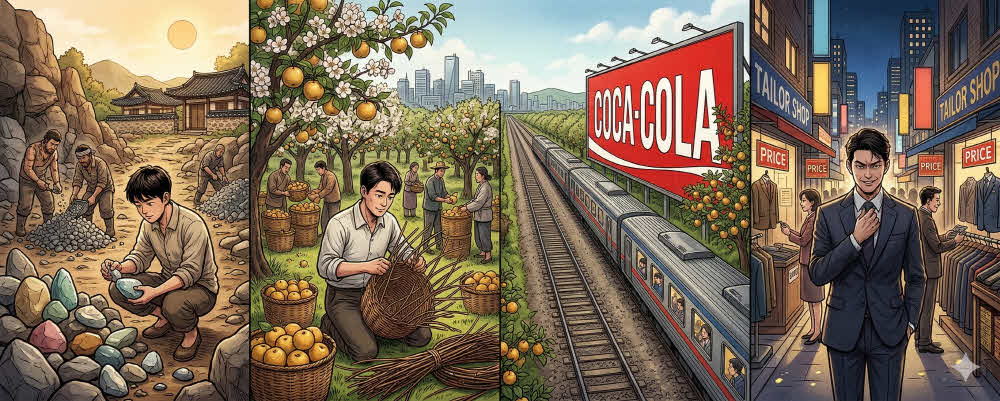
Dozens of young men were quarrying stones from a rocky mountain, breathing heavily.
Most of them crushed the stones into gravel. This was to sell them by weight to construction workers paving roads.
That was the only profit model they knew.
But one young man among them was different. He discovered peculiar patterns and beautiful curves within the stones that others had roughly broken.
He did not smash the stones. Instead, he carefully polished them and took them to flower shops and stone merchants in the city.
"This stone is a one-of-a-kind work of art in the world."
Its value, which was a pittance if sold as building material, transformed into a value dozens of times greater once it became a 'work of art' to decorate someone's garden.
Using this difference, he built the first tiled-roof house in the village. This was because, although he performed the same labor as others, his gaze rested on 'value' rather than 'survival'.
As time passed, leveling the mountains was banned, and the village transformed entirely into a pear orchard.
In autumn, lusciously ripened pears were exported all over the world, and the villagers enjoyed a more prosperous life than before by selling them.
People competed fiercely to harvest better pears.
Then, the young man who used to sell seeds suddenly cleared out the orchard and began planting willow trees.
People clicked their tongues. "Cutting down profitable pear trees to plant useless willows!
But he was reading the 'shortage' of the market.
The fact that the more pears were produced, the more woefully insufficient the 'baskets' to carry them overseas became.
While waiting years for the pear trees to bear fruit, he wove baskets from rapidly growing willow trees and supplied them exclusively. Five years later, he became the first person in the village to buy a house in the city.
When everyone else was trying to be the protagonist (the pear), he chose the essential item (basket) that would make the protagonist shine.
When a railroad was laid in the village, people began to think about building a factory.
However, instead of building a factory on his land, he erected a massive wall 100 meters long and 3 meters high along the railway tracks.
A stark wall suddenly appearing amidst a beautiful landscape covered in white pear blossoms on all sides. He knew that the passengers' gazes would inevitably linger there.
He turned the wall into an advertising billboard, and the global corporation Coca-Cola paid massive advertising fees every year in exchange for that 'exclusive gaze.'
He did not work. He merely guarded the 'path of the gaze,' watching where people were looking.
In the late 1990s, Shinichi Yamada, an executive at Japan's Toyota Motor Corporation, heard this rumor and set out to find him. However, the sight he witnessed was disappointing.
It was because that supposedly extraordinary man was screaming and fighting with the owner of the tailor shop across the street over a few pennies in the marketplace.
"If we sell it for 800 yen, they sell it for 750 yen! Where in the world are there such unethical scoundrels!"
His shop sold a mere 8 pieces a month, while the shop across the street sold 800. Yamada was about to turn away, thinking, 'Was I just a lucky businessman?'
However, he soon discovered a shocking truth. The fact that the competitor across the street selling 800 pieces was also owned by this man.
He had created a competitive situation for himself and cleverly exploited consumer psychology. Watching the price war between the two shops, people opened their wallets, convinced that "this shop is really cheap!"
The truth is, no matter which house he lived in, money was flowing into his pocket. Realizing this, Yamada immediately scouted him with an annual salary of $1 million.
"Truly terrible poverty is not the balance in a bank account, but the absence of imagination and creativity."
We often say that we cannot succeed because we lack capital or connections.
However, the power to see art in a single stone, read billboards in a landscape, and even design competition comes solely from 'flexibility of thought.'
Original ideas inevitably produce original results.
What is the 'ordinary stone' placed before you right now? Whether you crush it into gravel and sell it, or cultivate it into a one-of-a-kind ornamental stone and sell it, depends solely on your imagination.
Wealth begins not at the fingertips, but at the eyes that look at the world.