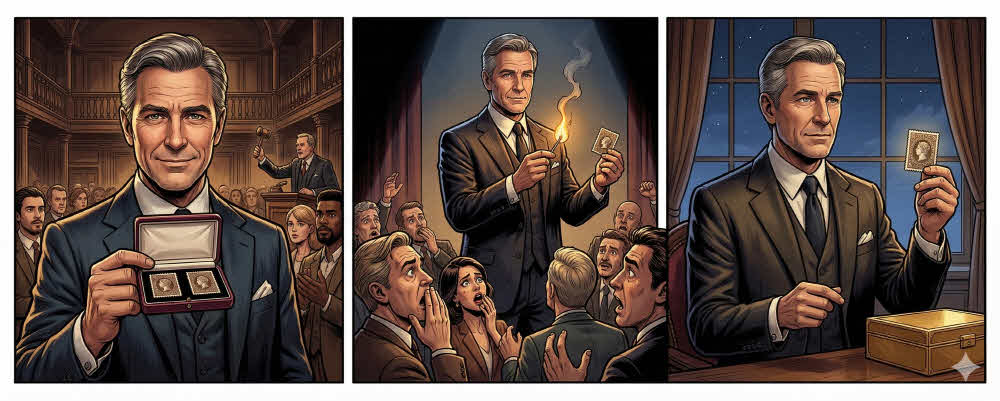
The hall was filled with suffocating silence. In an antique auction house in England, a legendary stamp—said to be one of only two in the world—lay on the stage.
Countless wealthy individuals vied with one another to call out numbers, and eventually, the tycoon 'Locke' acquired this rare piece of paper. The winning bid was a staggering 5 million dollars.
All eyes turned to him.
Locke walked onto the stage with a victorious smile, and in that instant, as everyone let out gasps of envy, an unbelievable sight unfolded.
Locke pulled a sleek gold lighter from his bosom and set fire to the precious stamp he had just won.
"Good heavens! He's insane!" "To think they just burned five million dollars—they should have donated it instead!" A shout mixed with anger and astonishment erupted. Locke simply smiled quietly. Then his assistant carefully opened another gold box. Inside, shining was the 'last' stamp remaining in the world, looking exactly like the one that had been burned. Holding up the remaining stamp, Locke asked the audience, "Ladies and gentlemen, until just now, this stamp was one of two five-million-dollar stamps. But now it has become the 'only one on Earth.' Now, what do you think this stamp is worth?" The people realized belatedly. What Locke burned was not a $5 million piece of paper, but the devaluation factor of 'commonness.' By eliminating one, he infinitely amplified the value of the remaining one. This powerful story resonates with the anecdote of the Chinese master Qi Baishi. His paintings were once recognized for their artistic excellence and traded at astronomical prices. However, at some point, his works began pouring out of major auction houses in Beijing, and as special auctions were repeated, the market's reaction grew increasingly cold. No matter how outstanding the art, the moment it becomes 'something that can be obtained at any time,' the mystery vanishes from people's hearts.
The law of art value that "anything in excess loses its value" is harsh.
This is because art stripped of its scarcity is no longer an object of admiration, but degenerates into a mere commodity.
Koreans uniquely cherish 'Jeong' (affection) and 'Jeongseong' (sincerity).
That is why we are captivated by a single piece of art completed by a craftsman after thousands of hammer blows, rather than by tens of thousands of items mass-produced by machines.
Isn't our lives the same? It makes us reflect on whether we are turning ourselves into common replicas of the world by following others.
We live in an era where everyone builds the same qualifications, speaks with the same tone, and chases the same formula for success.
However, as Locke's stamps demonstrated, true value comes from 'irreplaceability.'
Preserving the single sincerity only I can offer resonates far more powerfully than merely showing off a hundred talents.
This is because value is determined not merely by the number on a price tag, but by 'the reason why it must be that way.'
Scarcity: What makes me different from others? (Differentiation)
Modesty: Am I missing the core point by trying to show too much? (Simplification)
Uniqueness: Where is the realm where 'it has to be me'? (Irreplaceability)
The world always tempts us to have more, but sometimes the decisiveness to burn one thing away completes the value of the whole.