As we go through life, there are times when such thoughts suddenly cross our minds.
When a hollow sense of confidence rises, thinking, "I have worked hard enough and know pretty much everything, so why doesn't the world recognize my worth?" or "There isn't a single person around me I can learn from."
We all aspire to become masters in our respective fields and want to get ahead of others.
However, paradoxically, the very desire to climb to the highest heights can sometimes keep us stagnant at the lowest point.
Today, I suddenly find myself revisiting an old story about the elderly monk Si Yuan of Beop Hwa Temple and a young painter.
This story is not merely moralistic advice to "live a good life." It contains a very sharp insight into the 'potential energy' with which we approach the world.
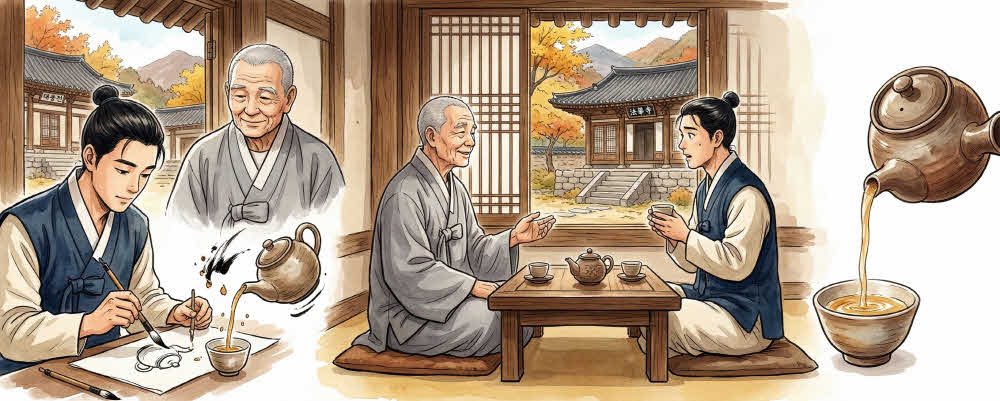
There was a young man who had come to Beopwhasa Temple after taking a long detour. His back was laden with numerous painting tools, and his eyes were a mixture of arrogance and weariness.
He confided his troubles to the head monk, Si Yuan. He said that although he had traveled across the country for over ten years, he had not met a single teacher capable of teaching him.
"Monk, there are too many people in the world who are all talk and no action. Even the paintings of the so-called famous artists I have seen are actually inferior to my own skill."
The monk simply smiled kindly and replied. "In that case, could you show this old monk your outstanding brushwork? I do not know painting, but I really love beautiful teaware. Please draw a teacup and a teapot for me." The young man confidently picked up his brush. On the paper, drawn with a single stroke, were captured an elegantly curved teapot and an exquisite teacup. Clear tea water was just about to drip from the spout of the teapot into the teacup. It was a perfect composition and craftsmanship by any standard. "The teacup on top, the teapot on the bottom?" Monk Siyuan looked at the painting and shook his head. "The picture is very nice, but the placement is wrong. The teacup should be on top, and the teapot on the bottom."
The young man burst into laughter as if finding it absurd. "Monk, where in this whole world is there such a rule?
If the teacup is above the teapot, how can you pour water? Water flows from top to bottom."
At that moment, the old monk's gaze deepened. "You understand that principle very well. Yet why are you living your life in the opposite way? You want to drink the fragrant tea of others' wisdom, yet you always place your 'mind teacup' higher than the other person's teapot. If you place yourself higher than the teapot, how can the wisdom of others flow into your cup?" This short anecdote makes us rewrite the modern definition of 'humility.' Humility is not about lowering oneself to become servile. Rather, it is the most strategic positioning to fully make the other person's wisdom one's own. There is a Korean proverb that says, "The more ripe the rice, the lower its head."
This goes beyond simply being polite; it means that the more full a person is on the inside, the more flexibility they possess to humble themselves in order to absorb more.
Think of the 'ocean,' which possesses the greatest energy in nature. There is only one reason why the ocean was able to accept the water from every valley and become the 'king of water.'
It is because it is situated in the lowest place of any stream or river in the world. Because it humbled itself, it was able to draw all the streams of the world into its embrace.
The teapot called the world is always ready to pour us fresh and hot tea of wisdom.
However, if that tea does not fill my cup, it may not be the teapot's fault, but perhaps because the height of my cup is too high.
True growth does not begin with a time to prove what I know, but when I acknowledge what I do not know and willingly lower my cup. You must empty to fill, and humble to make it flow.