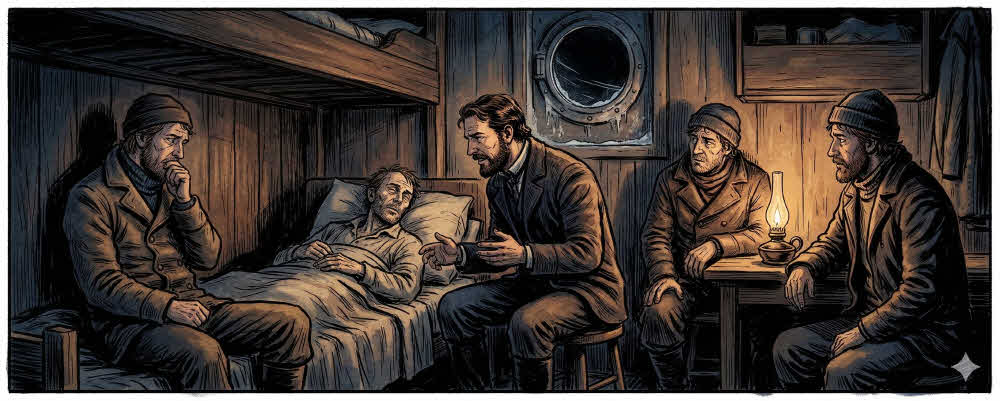
In 1898, the Belgian expedition ship 'Belgica' faced the harsh Antarctic winter head-on for the first time in human history.
Trapped in the ice due to an unexpected accident, all that was allowed to them was the endless 'Polar Night.'
After the summer on which the sun never set passed, what arrived was complete darkness where not a single ray of sunlight was permitted.
More terrifying than the cold fluctuating between tens of degrees below zero was the sense of isolation from being completely cut off from the world, and the silence that seemed to have no end.
Although there was plenty of food, 'psychological scurvy' slowly began to bloom in the hearts of the crew members.
As time passed, the vitality faded from the crew members' eyes. Some raged for no reason, while others did not utter a single word for days.
Just as an icy depression filled the ship, a man serving as the expedition's doctor suddenly began exhibiting strange symptoms.
He appeared to have fallen into severe depression. He refused food, stared blankly at the wall, and locked himself in a death-like silence, his entire body stiff as if he had become an Antarctic glacier.
Then, he suddenly displayed bizarre behavior, frantically devouring surrounding objects.
His colleagues were horrified. Everyone fell into despair at the fact that the doctor, who should have been the most level-headed, had collapsed first.
However, paradoxically, that despair united the crew. They willingly decided to open their mouths to save their comrade.
The comrades took turns sitting beside the doctor, who had become the 'patient,' and began to tell stories.
The warm scent of soup from home, memories of the fields where they played as children, even the excitement of an unfulfilled first love... At first, it was an attempt to soothe the patient, but strangely enough, a subtle warmth returned to the doctor's face every time a story was told.
The crew members whose turn it was not yet put their heads together to come up with stories to tell the next day.Imagination was the only free escape within the isolated ship.
And so, every night, 57 wondrous stories were woven onto the ice of Antarctica.
The saying that "stories have power" was true. While sharing stories, the crew members realized that they were not losers trapped in Antarctica, but protagonists writing a great narrative.
This 'storytelling,' which began to heal patients, eventually became a survival strategy that sustained the spirits of all of them.
When the long winter passed and the first rays of sunlight finally shone beyond the horizon, the 'mad' doctor rose from his seat before anyone else and returned to his usual calm demeanor.
In fact, his madness was a meticulously calculated 'fake.'
He knew. He knew that if they remained in this silence, everyone would go mad. So, by sacrificing himself and becoming a 'being in need of care,' he created a reason for his crew to live and a justification to connect with one another. His feigned depression was, in fact, the most fervent humanity intended to save his comrades. Sometimes we pass through the 'polar night' of life. Trapped in economic crises, severed relationships, or an inexplicable emptiness, we feel as though the sun will never rise again. However, the truth taught by the miracle of the Belgica is clear: what saves us is not flashy technology or overflowing resources, but the 'warmth' of listening to each other's voices and sharing our hearts.