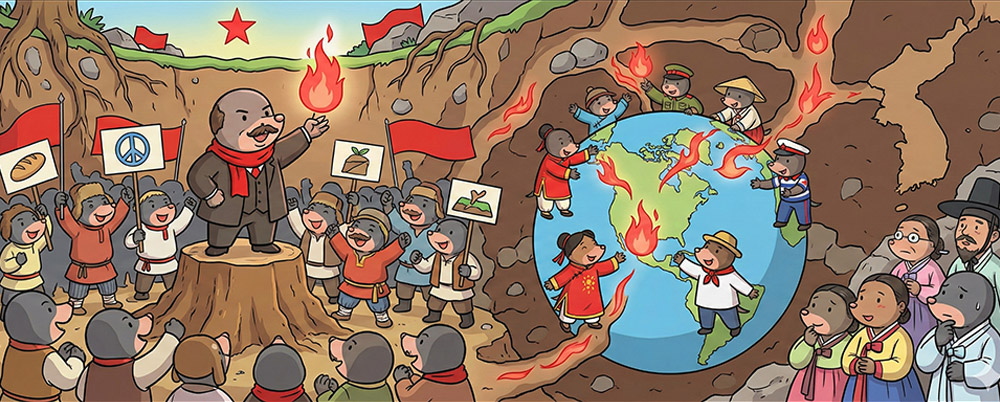
"Bread, peace, and land!" In 1917, to the Russian people exhausted by the fires of war and starvation, this short sentence was salvation.
At its center was a revolutionary with cool intellect and fiery drive, Vladimir Lenin.
He brought Marxism, which had remained merely a theory, into the realm of politics.
Amid the chaos following the collapse of the monarchy, he proposed a new power structure called the 'Soviets (Councils)' and gave birth to the first socialist state unprecedented in human history.
Lenin's influence was not confined within the territory of Russia.
He turned his attention to the weak nations of the world groaning under imperialism.
"Oppressed peoples of the world, unite!
The 'Comintern (Third International)' led by Lenin declared that it would actively support colonial liberation movements.
This message caused a huge stir among our people, who were under the oppression of Japanese imperialism at the time.
To us, Lenin is a truly complex figure.
In the 1920s, to independence activists whose yearning for independence had reached its peak, Lenin's Russia was also a 'strategic partner' that promised substantial financial and military support.
From the days of the Provisional Government in Shanghai to the independence fighters on the plains of Manchuria, many sought clues to an 'equal world' and 'national liberation' in Lenin's ideology.
However, this spark later became the tragic seed of ideological conflict, serving as the historical backdrop for the division of the Korean Peninsula.
Although Lenin passed away in 1924, the system he created became a massive current that shook one-third of the world's population.
It served as a powerful stimulus that made capitalist nations pay attention to workers' rights and welfare.
It became the starting point of the Cold War and completely redrew the maps of Asia and Eastern Europe.
It also left a painful lesson that the aspiration for absolute equality can sometimes degenerate into another form of authoritarianism.