A glass of fresh milk on your table, and vaccinations for children.
Do you know that this daily life, which we take for granted, was once a 'life-or-death gamble'?
In those days when people had to say goodbye to their families without knowing the cause, there was a man who changed the fate of humanity.
That man is the father of modern medicine, Louis Pasteur.
Until the 19th century, people believed that microorganisms spontaneously arose from rotten meat or stagnant water.
This was called the 'theory of spontaneous generation.' But Pasteur was different. He was convinced. "That life comes only from life."
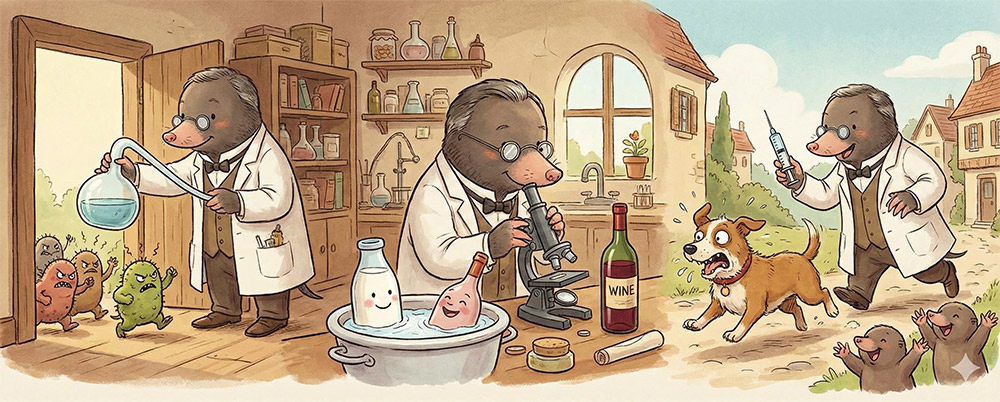
Through the legendary 'Swan Neck Flask Experiment,' he proved that microorganisms cannot reproduce if dust and bacteria in the air are blocked.This simple yet great discovery became the foundation of the 'Germ Theory' of disease, and
it was the moment when humanity finally came face to face with the 'true nature' of disease.
For Koreans, 'family' is a value more precious than anything else.
Pasteur also experienced a personal tragedy, losing three of his five children to typhoid fever.
That sorrow soon became obsession.
"Science knows no borders, but scientists have a homeland."
He developed pasteurization for the farmers of his homeland, France, to prevent the spoilage of wine and milk, and saved the lives of countless children from the terrifying disease known as rabies.
The anecdote of farmers who traveled from Russia to France to receive rabies vaccines at the time still evokes a deeply moving emotion.
Pasteur's spirit lives and breathes at the roots of every action we take, such as washing our hands, cooking our food, and preventing infectious diseases through vaccines.
He was not merely a scholar confined to a laboratory. As he said, "In the realm of observation, opportunity comes only to a prepared mind," he was a man of action armed with thorough preparation and fervent humanity.