In life, everyone experiences moments when they feel like they are 'losing.'
When a project you worked hard to prepare collapses, or when you are rejected by someone you trusted, we unwittingly engrave the word 'defeat' in our hearts.
However, here is a man who, in the same situation of defeat, changed the order of a few words to turn a death sentence into praise.
This is the story of Zeng Guofan, the greatest strategist and politician of the Qing Dynasty.
It was 19th-century China, during the height of the Taiping Rebellion. Zeng Guofan, the commander of the Xiang Army, suffered devastating defeats in successive battles.
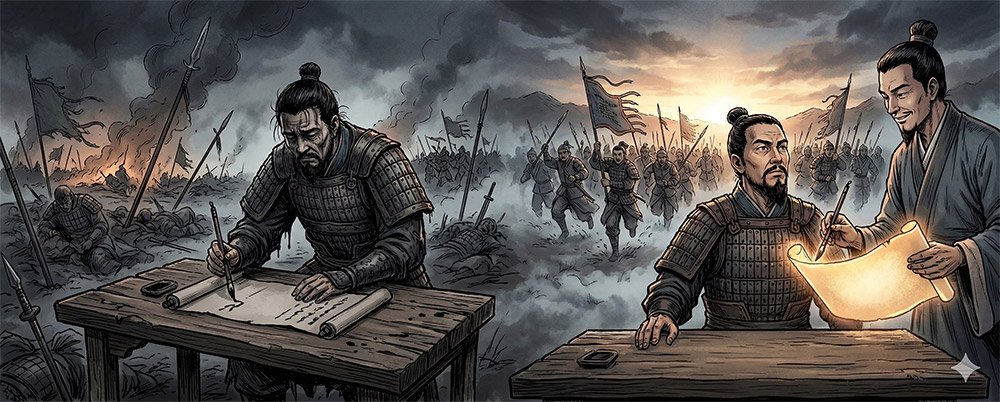
At the moment he had to report the war situation to the Emperor, the tip of his brush was trembling.
The first sentence he wrote was this:
"I have lost every battle I have fought (Nujeonnupae, 屢戰屢敗)."
This was true. However, conveying 'facts' exactly as they are is not always the 'truth'.
If this report had been delivered to the Emperor, Zeng Guofan would have been branded an incompetent commander and would have found it difficult to preserve his life.
At that moment, a strategist standing nearby snatched the brush and slightly changed the order of the sentences.
"Although I have been defeated every time, I continue to fight (Repeated defeats and repeated battles)."
The four characters remained the same, but the meaning changed 180 degrees.
Repeated battles and repeated defeats: 'An incompetent person who loses every time he fights 'Repeated Defeats and Repeated Battles': 'An indomitable warrior who rises again without yielding even amidst the pain of defeat' The Emperor was deeply moved upon receiving this report. Instead of punishing Zeng Guofan, he trusted in his 'unyielding spirit' and offered him his full support.
Ultimately, Zeng Guofan won the war with this attitude and became a hero of history.
The archetype of 'seven falls, eight rises' or 'the important thing is an unbroken mind (Jung-kkeokma)' lies right here.
If you get bogged down in the fact that you failed, you become a 'loser,' but if you focus on the fact that you tried despite the failure, you become a 'challenger.'
In job interviews, business meetings, or conversations with yourself, instead of saying "I failed," talk about "what you learned in the process and how you got back up."Words define thoughts, and thoughts create actions. Instead of asking yourself, "Why can't I do it?", you must ask, "How can I fight again?"
"I wavered again today, but I still stand here."
Just as Zeng Guofan's strategist did, if you shift your perspective just a little, a record of defeat becomes the prelude to a great victory.
You are not losing because you are incompetent. You are simply fighting without giving up until you win.