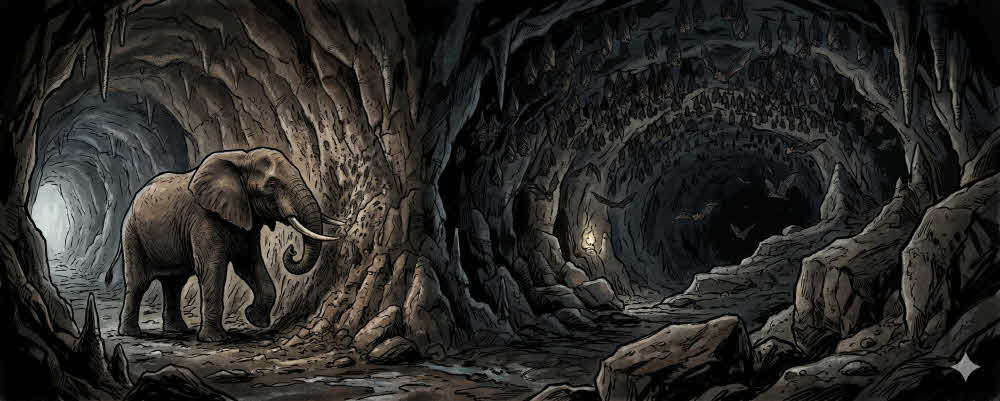
The caves we usually picture are mysterious landscapes where cool breezes flow and stalactites fall from the ceiling.
However, Kitum Cave holds a story entirely different from such romantic images.
This place is a colossal record of survival written by nature over tens of thousands of years, and at the same time, a site that delivered the most ominous warning to humanity.
During the day, the entrance to the cave is peaceful.
But as the sun completely sets and the forest is enveloped in darkness, the landscape gradually changes.
Giant shadows begin to move quietly within the forest.
They are elephants.
They enter the cave one by one, just like miners heading to work.
A multi-ton body slips into the darkness, and a moment later, a dull thud echoes from deep within the cave.
It is the sound of tusks striking rock.
The elephants are smashing the walls.
It is not just a simple game.
What they are after is the salt hidden within the rocks.
For herbivores, salt is a nutrient directly linked to survival.
That is why these massive animals have been repeating the same task for thousands of years.
They use their tusks like pickaxes to carve away at the walls and lick up the salt inside.
This scene is just like elephants mining every night in a mine created by nature.
If human coal mines extract black coal, here, colossal creatures extract white salt from within the rocks.
As a result, the cave grew deeper and deeper.
Layers of scratch marks made by ivory are etched into the walls.
They are the traces left by thousands of generations of elephants, a vast chronicle created by nature.
However, this magnificent site of survival simultaneously harbored an unseen danger.
In the 1980s, several people visiting this cave began to collapse from unexplained high fever and bleeding.
The sight of a perfectly healthy person vomiting blood and their body collapsing within days looked as if an invisible hunter were snatching a human being.
The name of that terror was the Marburg virus.
And it was also a place connected to another name that later plunged the world into even greater terror: the Ebola virus.
In 1980, a Frenchman explored this cave.
His name was Charles Monet.
After finishing the exploration, he suffered from a sudden high fever, and soon bleeding began throughout his body.
Symptoms that seemed as if his body were collapsing on its own followed, and eventually, he lost his life.
Scientists were shocked.
Where on earth did this death begin?
After tracking it down, what they discovered were black shadows hanging from the cave ceiling.
Tens of thousands of bats were densely packed on the ceiling, and the species was Egyptian fruit bat.
The air inside the cave was filled with virtually invisible dust.
Bat excrement, saliva, and fine particles were floating around inside the cave.
The air was like a poisonous fog spreading quietly.
Although invisible and odorless, a virus capable of destroying human life was lurking within it.
The moment a person inhales, the virus seeps into the lungs and silently takes over the body.
The cave was not a mere natural space.
On the surface, it looked like a peaceful mine where elephants mined salt, but
hiding in its ceiling was a massive biological reservoir containing one of the deadliest viruses in human history.
Just like a giant vault created by nature.
And humans had, unknowingly, briefly opened the door to that vault.