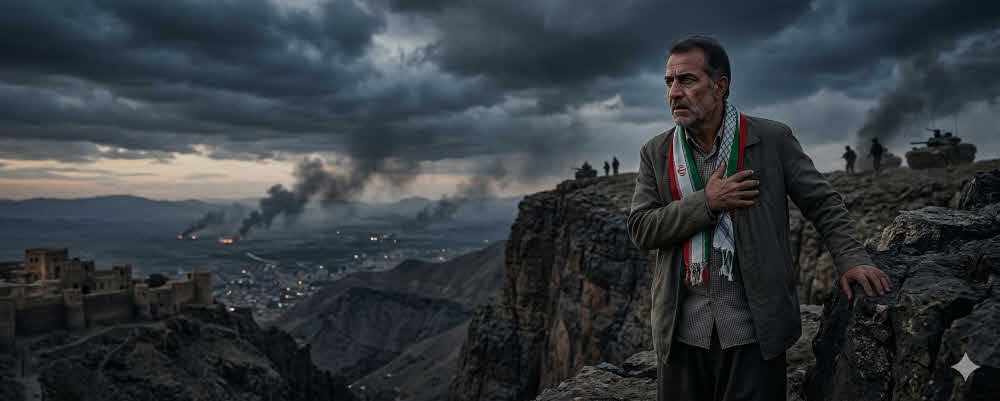
The low, rough roar of the Middle East heard in the news feels like distant thunder.
However, that sound is not merely a change in weather, but the moment when the cracks of tension, built up over decades, burst open.
And at the center of those cracks always stands one country.
Iran. Many people ask, “Why is that country always at the center of problems?”
But if you look a little deeper into this question, hidden within is not the story of a ‘country causing problems,’ but of a ‘country holding out to the very end.
This story begins like the narrative of two families entangled in a long-standing grudge.
In 1979, an event occurred in Iran that overturned history, like a massive stream changing direction.
The Islamic Revolution. With the collapse of the pro-American monarchy and the rise of a new regime, relations with the world were severed, much like a well-connected front line snapping in an instant. From that moment on, the perception of Iran changed completely. To the U.S., it was a disobedient variable; to Israel, a threat that could erupt at any moment; and to Iran itself, a shadow always lurking in its back. Mutual distrust piled up like an invisible debt, reaching a point where the interest continues to grow without even knowing what the original principal was. Added to this is the word "nuclear." Like a spark that can set a mountain ablaze with a single match, this word possesses a power small yet capable of changing everything. Outside, people say, "That is a dangerous weapon." However, Iran's true intention is slightly different: "Without this, we could be erased." To them, nuclear weapons are closer to a shield than a sword. They are a final distance designed to prevent the opponent from wielding them easily, like an invisible boundary line that prevents two people standing facing each other from taking even a single step closer. The fear that without that line, someone would have already crossed it holds them captive. And that fear is not merely a figment of imagination. The long-standing sanctions were like an invisible rope slowly tightening around Iran. Unable to sell oil, with the flow of money blocked, the economy begins to gasp for breath like a person unable to breathe. Currency values become as light as paper, prices inflate like balloons, and people's lives hit rock bottom. In a reality where even a warm meal has become a luxury, the choices become simple: Will they wither away like this, or will they take the risk and take action? A cornered entity always reacts much more violently than expected. It is akin to instinct. Iran begins to build its own fences around itself to avoid being alone, or to prevent itself from being alone. Lebanon, Yemen, and allied forces scattered across various regions. This is not merely an alliance; it is akin to lighting several bonfires on a winter night to share body heat. This is because if one goes out, the whole thing becomes colder. However, when those bonfires begin to die out one by one, the remaining fires either burn brighter or struggle desperately to hold out until the very end. The recent series of attacks must have felt like such a signal to Iran. A message heard without the words, “You’re next.” And eventually, the moment the line is crossed arrives. Having one’s own facilities attacked and key figures targeted is like being stabbed in the heart for a nation. This is not merely a diplomatic conflict; it is a situation where one’s very existence is being tested. At this moment, any country reacts before it calculates. Because remaining passive is tantamount to denying itself. So, they move. Even knowing that it will trigger even greater repercussions. When we combine all these trends, the direction Iran is heading is surprisingly simple. It is neither victory nor conquest. Just one thing: survival. Not to bring the opponent down, but to prevent them from attacking easily. Just as a hedgehog curls up and raises its quills, it is sending a signal not to come near.
Those quills are a warning, not an attack.
The complex conflicts of the Middle East may appear to be stories of religion or ideology, but beneath them flows a much more primal question.
“Who will remain until the end?” Iran’s choices may be a nation’s answer to that question.By standing firm like a heavy stone, so as not to be swept away by the massive current.