The sages of old said:
Weapons are tools born harboring the shadow of misfortune, and for a wise man, even the moment he draws one must be his final scene.
However, the world we stand in today, 2026, seems to be flowing in a completely different direction, having left that ancient wisdom tucked away in a dusty drawer.
It looks like a massive train with broken brakes enjoying its speed, racing faster and toward a more dangerous curve without being able to stop.
The news we have been hearing recently goes beyond the level of simple conflict.
It sounds not like gunshots or explosions, but like a signal that human senses themselves are gradually becoming dulled.
For some, war is still the end of life, but for others, it is consumed as a single scene, an event, or even ‘sensational content’ that stirs emotions.
In particular, a certain gaze flowing from the center of power starkly reveals the rifts of this era.
It feels as if the hands moving the pieces are converting the lives within into points, looking down on the world like a giant game board. That is why the ‘three happinesses’ mentioned here sound even more chilling.
It is not laughter, but a coldness mimicking laughter.
The first scene is the strange pleasure created by overwhelming force.
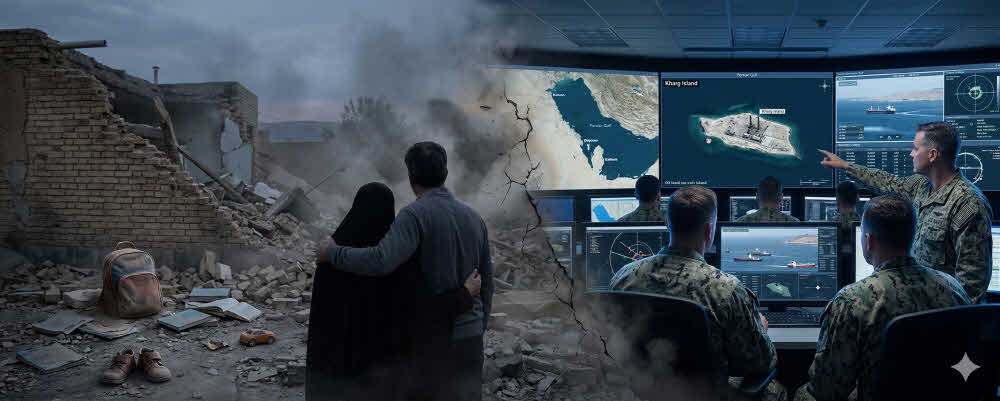
The moment an unarmed vessel, quietly cutting across the sea, is dragged down into the deep ocean without any warning. It begins like the ripples spreading when a stone is thrown onto calm water, but beneath those ripples lies a deep darkness where dozens of lives are simultaneously fading away. However, some of those observing this scene describe it as "entertainment" rather than "efficiency." The remark that sinking is more interesting than capture sounds colder than a bullet. This is because it is not physical destruction, but the collapse of emotions. The second scene is a story aimed at an invisible heart. The name Harg Island appears as a small dot on a map, but it holds the very breath of a nation. The bombing directed at it is not merely a blow, but like a hand tightening its grip. Yet, this too is consumed like a highlight scene in a video game, accompanied by the label "the most powerful operation in history."
The phrase "you can do it a few more times" sounds like an event repeatable with the push of a button.
However, what repeats in reality is not the score, but pain, anxiety, and never-ending tension.
The third is the most dangerous emotion: ‘addiction to victory.’
Victory should inherently be a result, but the story changes the moment it becomes the goal.
The attitude of declaring oneself a winner at every moment and attempting to reorganize relationships based on hierarchy rather than cooperation turns international affairs into a grand family drama.
The moment the question of ‘who is superior’ pushes aside the question of ‘what is right,’ diplomacy transforms from dialogue into a display of power.
And those pushed out of that game lose their voice.
However, behind the dazzlingly packaged story of victory, there is always a rift.
A will that does not crumble no matter how strong the pressure applied exists like a reed that merely bends in the wind but does not break.
History has proven countless times that physical destruction cannot destroy the spirit.
In a sense, invisible resistance is flowing beneath the water that appears calm on the surface.
And that shock inevitably returns.
The moment an oil tanker passing through the Strait of Hormuz comes to a halt, it is not merely a local issue but creates ripples in prices and lives across the globe.
Just as waves originating in the distant sea eventually wet the ankles of the shore, the economy is connected in that way.
Someone's strategy becomes someone's livelihood, and someone's decision shakes someone's tomorrow.
Alliances, too, are no longer the same as before.
The chorus that once resonated as one voice is now splitting into individual pitches.
The fact that gazes that once converged on a leader are increasingly shifting toward suspicion and distance signifies not merely a diplomatic shift, but a rift in trust.
This is because leadership is not maintained by power, but by trust.
And at the end of this entire story, we are bound to face a scene.
Reports organized by numbers: how many dead, how many injured. However, if you look closely at each of those numbers, within them lie names, days, and dreams.
The footsteps of children heading to school, the laughter shared with friends, the ordinary day looking forward to tomorrow. The fact that all of this vanished in an instant cannot be lightened by any political interpretation.War always has two faces.
From afar, it is a strategy; up close, it is a tragedy.
To some, it is just a line on a map, but to others, it becomes a home they cannot return to.
Therefore, what we must not forget is that at the center of this grand story, there are always people.
The moment force replaces justice, the world may move fast, but it cannot last long.
Like a castle built on sand, it appears magnificent on the outside, but it is bound to collapse with a single wave.
Hoping that the noise we are hearing now does not end as mere news, and that the voices buried within it do not completely disappear,
we are reminded once again that, ultimately, what we must choose is not speed, but direction.