For the past few years, we have lived habitually using the phrase ‘turbulent times’ as if it were a matter of the weather.
However, perhaps the changes we have experienced were not in the middle of a storm, but rather the moment before the storm when the sea quietly catches its breath.
The real change has not yet begun, and the world is now quietly, yet in a very significant direction.
Just as a massive iceberg changes course silently, it may appear as though nothing is happening right before our eyes, but the course is changing completely.
If you look closely at the flow of history, major changes have always started in one place and spread like dominoes.
In 2026, it is highly likely that the first domino will fall in the Middle East.
The Middle East has always been called the world's powder keg, but paradoxically, it is also the place where fires first ignite and first go out whenever the world order shifts.
If tensions in this region begin to resolve faster than expected, it is not merely the end of a war, but
a signal that the flow of energy, money, and power is changing direction entirely.
Oil prices are like the body temperature of the global economy; only when the fever drops do people begin to catch their breath.
When energy prices stabilize, prices fall; when prices fall, interest rates fall; and when interest rates fall, money begins to flow toward risk again.
Just as water flows when a frozen river thaws, stalled investments and industries begin to move again.
For a country like Korea that relies heavily on imports for energy, this is akin to a caravan crossing a desert encountering an oasis.
Just as a sip of water can change one's survival, a single energy price can change the fate of a nation.
Once the flames in the Middle East subside, the scene naturally shifts northward.
The wars that have stood at the center of world news until now are also inevitably bound to come to an end.
War is more difficult to end than to begin, and its aftermath is more terrifying than victory.
This is because, while tanks and missiles fight on the surface, it is actually a battle that consumes time, money, and the lives of the people.
As the war drags on, it begins to destroy the nation's interior rather than the front lines.
Even seemingly magnificent empires, when cracks begin to form from within, may appear to collapse suddenly one day, but in reality, they have often been rotting for a long time.
When a giant tree falls, it makes a loud noise, but what brought it down may not have been the wind, but the time that was hollow inside.
As time passes a little further and around 2030, it is highly likely that the world will have a map that looks quite different from what it does today.
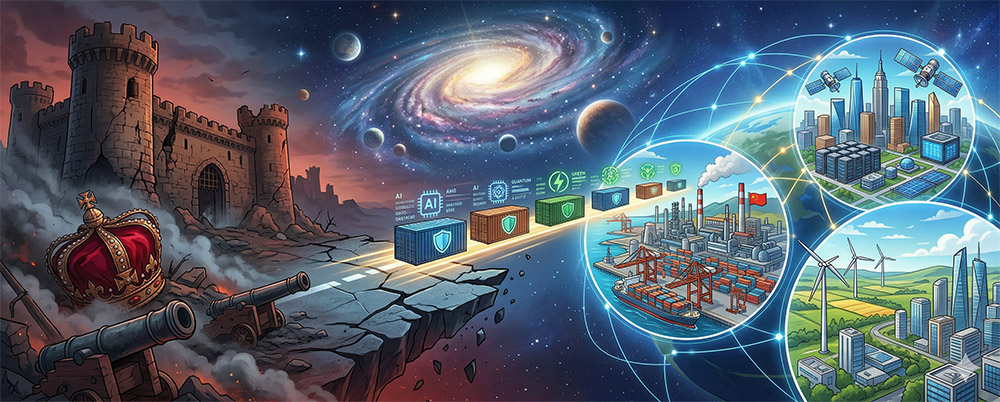
It is a shift from an era where a single nation decided everything to an era where multiple major axes check and balance each other.
Just like how an era ruled by a single emperor has given way to an era where three kings are conscious of one another and carefully maintain a balance.
In this balance, invisible warfare takes precedence over all-out war; technology takes precedence over guns; and scientists and corporations take on more important roles than soldiers.
In the past, nations with vast land holdings were strong, but now it is becoming an era where nations possessing vast amounts of technology and data become powerful.
It is an era where power lies not in territory but in servers, not in oil but in semiconductors, and not in military forces but in artificial intelligence.
Amidst this massive trend, the nation of Korea stands in a rather unique position.
Although it is not a large country when viewed on a map, it stands at a crucial crossroads, much like a port situated between the sea and the continent.
Such a country can quietly make money when the waves are calm, but when the waves become rough, its fate changes drastically depending on which side it stands on and how it maintains balance.
Therefore, in the coming era, ‘which direction one goes’ will become more important than ‘how fast one goes.’
We are entering an era where direction is more important than speed, safety more important than efficiency, and dispersion more important than concentration.
If the world of the past was an era of building factories in the cheapest places, it is highly likely that the future world will shift to an era of building factories in the safest places.
We are moving from the logic of money to the logic of survival, and from the era of efficiency to the era of risk management.
Therefore, fields such as artificial intelligence, quantum technology, energy, and semiconductors are becoming not merely industries for making money, but industries connected to the survival of the nation.
If there was an era of making swords and shields, now is the coming era where nations that make chips and electricity will survive.
When viewed from a distance, similar scenes always repeat themselves.
Strong nations collapsed from internal rifts rather than from external wars, while small nations survived for a long time by maintaining a good balance rather than disappearing between great powers.
A massive rock shatters all at once, but water changes shape and eventually makes a path.
Therefore, what is needed in the coming era may not be just strength, but the eye to read the direction and the wisdom not to stake everything on one side.
The approaching time comes with the face of crisis, but it always comes clothed in the garment of opportunity.
If you tie up your boat when the waves come, it will capsize, but if you raise the sails, you can go far.
Ultimately, the same wave becomes a disaster for some and a breeze for others.
Perhaps the important thing is not to eliminate the waves, but to learn how to ride them. The year 2030 may not be a distant future, but rather the name of a massive wave already surging toward us. The nation that does not lose its direction on that wave is highly likely to become the master of the next era.