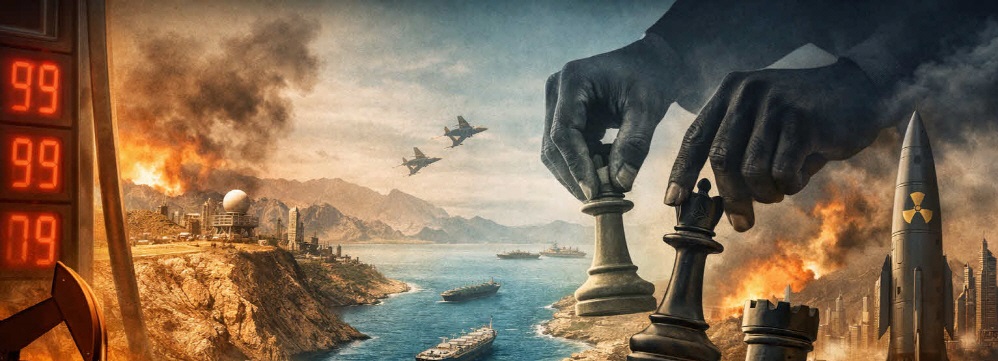
You have likely experienced your heart sinking the moment you see the numbers on the gas station display board on your way to work in the morning.
It feels like you are living exactly the same life as yesterday, yet the world is rewriting the price tag behind your back.
However, the story changes a little if you consider that the starting point of those numbers is not our neighborhood, but a tiny, narrow sea channel that looks like a fingernail on the map.
Just as if someone is secretly holding the valve of a massive water pipe, the massive current of the global economy accelerates and suddenly comes to a halt as it passes through that narrow path.
We have commonly been taught that the world is like a chessboard where nations fight each other.
But if we shift our lens just a little, the real players on this chessboard might not be national flags, but the flow of money.
The state is literally just a figurehead, like a horse or a castle, and there are times when it seems as though there are people reading the game from behind the scenes.
Money knows no borders, and capital has no passport.
Just as water flows from high places to low places, money flows to safe and strong places.
And what that money loves most is ‘order’ and ‘energy.’
Money grows only when there is order, factories run only when there is energy, and numbers—whether dollars or yuan—only have meaning when factories are running.
Therefore, oil is not just a simple black liquid, but is like the blood of modern civilization.
It doesn't just move cars; it creates plastic, clothes, and fertilizer, and ultimately, it even moves the price of the food we eat.
Among the blood vessels through which this blood flows, the most important artery is the Strait of Hormuz.
A large proportion of the world's oil passes through this narrow channel, and it is shaped like the waist of a giant hourglass.
No matter how much sand pours down from above, if the waist is blocked, not a single grain can fall down.
This is exactly how the global economy views Hormuz.
Rather than the vast ocean, the narrowest place moves the world.
For Iran, this strait is not just a sea, but a lifeline, a bargaining chip, and a last resort insurance.
It is similar to the feeling of holding onto the last remaining rook when the king is cornered in chess.
Normally it appears like a road quietly floating on the sea, but Iran knows, the United States knows, and Russia and China know that if the situation is pushed to the extreme, this single road could bring the world to a standstill.
That is why this is a place where calculators run busier than guns, and exchange rates move before missiles.
The world is currently akin to a massive tug-of-war.
One side is pulling the dollar and the existing order, while the other side is attempting to create a new order, a new currency, and a new energy path.
On the surface, the news features words like war, airstrikes, and sanctions, but looking from a distance, that is just the white part visible on the iceberg; beneath the water, much larger chunks of ice are pushing and pulling against each other.
War does not erupt suddenly; it is closer to long-accumulated pressure bursting through the surface at a certain moment.
Just like an earthquake gathers power deep underground for a long time before shaking everything up all at once.
And there is one scene that always repeats itself in history.
Whenever the world undergoes a major change, the ‘path of money’ and the ‘path of energy’ always change together.
There was an era when the nation that controlled the sea routes controlled the world, an era when the nation holding coal became a superpower, and an era when the nation holding oil became the world's police.
We may now be standing at a crossroads where those paths are changing once again.
That is why the events unfolding around the world these days do not appear as isolated incidents, but rather as connected dots drawn on one large map.
It is not without reason that talk of nuclear weapons arises. Nuclear weapons are less weapons for victory and more like a last resort to avoid defeat. They are like invisible lines drawn on the ground by each side, saying, "Do not come this far." A situation where one step closer to the edge of a cliff means falling together, a situation where one cannot easily move even while looking into the other's eyes—perhaps the current global situation resembles this. If so, are our lives too small within this grand narrative? Not necessarily. A single event unfolding in the narrow strait across the sea changes the price of oil, oil prices change logistics costs, logistics costs change prices, prices change interest rates, and interest rates change the value of housing, stocks, and salaries. Ultimately, a single wave in the Strait of Hormuz shakes the numbers in our bank account balances.
It may be a distant storm, but eventually, it shakes the windows of our own homes as well.
Perhaps we are not sitting in the spectator seats of history right now, but are actually riding together on a massive ship.
News is a broadcast that tells us the height of the waves, and oil prices and interest rates are like a compass that tells us the direction of the wind. We cannot stop the storm, but if we know the direction of the wind, we can choose how to unfurl the sails.
Therefore, reading the story of the world today is not merely about understanding international politics, but is akin to sniffing out the scent of the wind that is yet to blow.
The world always changes direction when it is quiet, and people only realize this fact after it becomes noisy.
Perhaps we are living in an era where the sound of calculators and oil tanker engines should be heard louder than gunshots. And that sound seems to be coming from very far away, but in fact, it might already be right beside our daily lives.