As we go through life, there are times when we feel as though we are standing before a massive wall.
Amidst walls that do not budge no matter how hard we push, and conflicts with no end in sight, we often blame ourselves, thinking it is because we lack 'strength.'
However, about 1,800 years ago, during the late Eastern Han Dynasty, a young boy offers us a completely different answer. This is the story of Hua Tuo, who would later be called the Divine Physician.
This is the story of when the seven-year-old Hua Tuo visited Physician Cai, who was the greatest physician of his time.
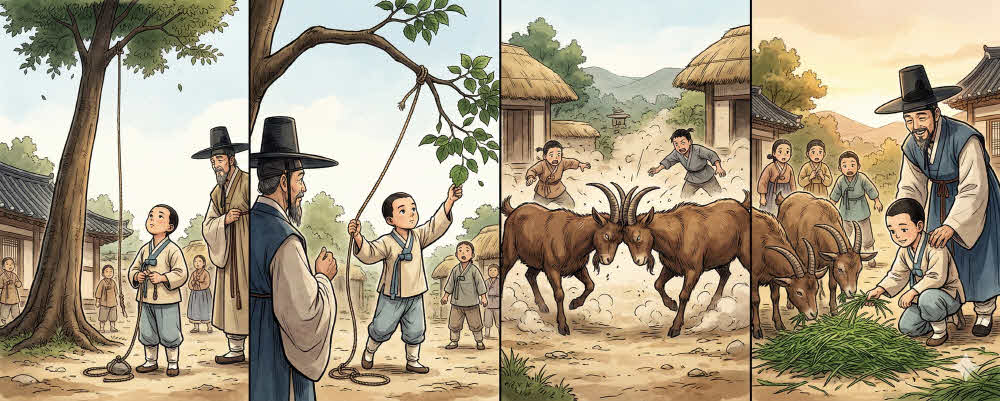
Among the numerous aspiring disciples, Assemblyman Chae took notice of Hua Tuo, whose eyes were exceptionally clear, and decided to test his intelligence.Pointing to the large mulberry tree in front of the house, the Assemblyman asked, "I need to pick a leaf from the very top of that high branch, but I cannot reach it. I have no ladder, and climbing the tree is not an easy path, so what should I do?"
A typical child might have paced anxiously or waited for someone to help.However, Hua Tuo fell into thought for a moment and began to survey his surroundings.
Then, he picked up a rope and a small stone that were rolling around somewhere.
Hua Tuo threw the rope tied with the stone with all his might, wrapping it around the high branch.
Then, he gently pulled the rope downward.
The branch that had been standing upright toward the sky humbly bowed its head before the boy's hand, and Hua Tuo obtained the fresh mulberry leaf with remarkable ease.
Here, we realize an important fact.
When a problem seems too high up, what we should be concerned about is not 'how short I am,' but a shift in thinking: 'how can I bring that high thing down to my level?'
Assemblyman Chae's second test was even more tricky. Two goats were butting horns and fighting fiercely in one corner of the yard.
Even though burly men clung to them to separate them, the angry goats were relentless.
"Stop that fight. However, you must not hurt them."
Hua Tuo did not confront them with force this time either.
Instead, he ran to the mulberry tree where he had picked the grass just moments before and broke off a handful of fresh, green grass.
Then, he gently held the grass to the noses of the two fighting goats.
The result was astonishing.
The goats, who had been fighting to the death, instantly stopped fighting and began to graze on the grass.
In the face of the fundamental need of hunger, their anger vanished like melting snow.
What moves the other person's heart is not oppression, but rather the 'insight' of grasping what they need most at that moment.
Our daily lives are no different from Hua Tuo's testing ground.
At work, we face the 'tall tree' of performance that seems impossible to climb, and in human relationships, we get entangled in conflicts resembling a 'fight between goats' that are difficult to bridge.
In such times, we often recklessly climb the tree and fall, or get caught between fighting goats and get hurt along with them.
However, the wisdom Hua Tuo demonstrated lay in 'detours' rather than 'going straight ahead.'
If there is no ladder, throw a rope; if you are short, lower a branch. Rather than blaming the lack of tools, the flexibility to consider how to utilize what you have creates achievement.
When resolving conflicts, fulfilling 'needs' is faster than blaming. It was not a club, but a handful of fresh grass that stopped the fight.
The saying "Success comes from prudent thought" is by no means an empty phrase.
The secret to how Hua Tuo did not remain an ordinary child but became a Physician who left his name in history lay not in his medical skills, but in his deep and prudent attitude toward problems.
Those who give up easily when faced with difficulties end up walking only the paths paved by others.
However, those who ponder, like Hua Tuo, "How can I be different?" create their own paths.
Doesn't the principle of 'Gung-jeuk-tong' (窮則通), meaning that when you are at your wit's end, a way out, as spoken of in Korean sentiment, ultimately refer to the wisdom that emerges from earnest contemplation?
Are you perhaps sighing while gazing only at the highest points?Perhaps the small stone and rope that Hua Tuo picked up, or a handful of fresh grass to lull a goat to sleep, lie at your feet as well.
Thinking just a little deeper, thinking just a little differently. That subtle difference transforms an ordinary life into an extraordinary history.
I hope you will cherish this warm yet sharp question that Hua Tuo's childhood poses to us in your heart today.