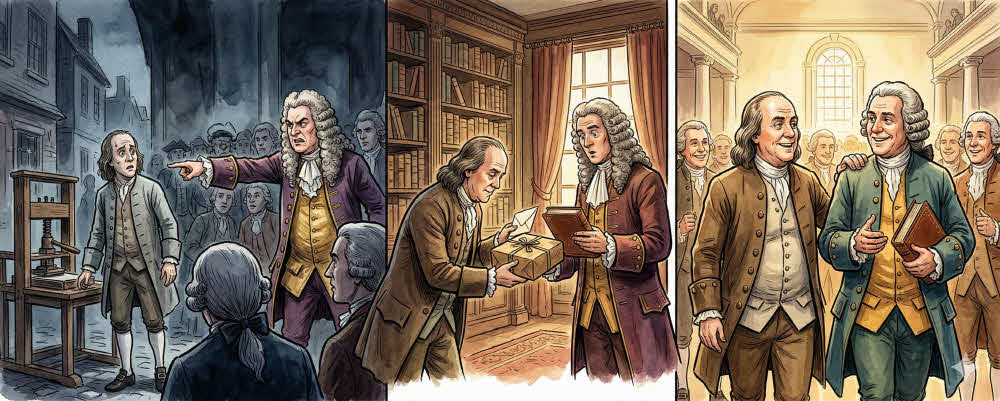
In his youth, Franklin was a young man overflowing with ambition.
He spent his entire fortune to purchase a small printing press and worked tirelessly to secure the printing of Congressional documents.
However, he encountered a major obstacle. This was because a congressman with immense influence in Congress at the time intensely disliked Franklin.
That congressman criticized Franklin in public and
hindered the growth of his business. For the young Franklin, who lacked both connections and money, the hatred of a powerful figure was a threat to his very survival.
An ordinary person might have lost sleep over the injustice or tried to find the congressman's weakness to take revenge.
But Franklin was different. Instead of subjugating his enemy, he began to ponder the most elegant way to make him 'my ally'.
Franklin did not flatter or kneel before the congressman.
Instead, he devised a very peculiar strategy. Hearing rumors that the other party possessed a very rare book, he sent a polite letter.
"Congressman, I have heard that there is a very rare and special book in your study.
I have always wanted to see that book, and if you do not mind, could you lend it to me for a few days? I will read it carefully and return it to you.
At first glance, it seems like a simple request, but a sophisticated psychological warfare was hidden within it.
When the opponent, who had only ever criticized him, suddenly asked for help with the nuance of 'I respect your insight and collection,' a subtle crack formed in the congressman's heart.
The result was surprising. The congressman immediately sent the book, and a week later, Franklin returned it along with a letter of sincere gratitude.
When they met again at Parliament some time later, the congressman, who had always been cold, approached first and greeted him.
He treated Franklin with unprecedented politeness, and from then on, the two became inseparable friends for life.
In psychology, this is called the 'Benjamin Franklin Effect.'
We usually think that we help someone we like, but from a neuroscience perspective, the opposite phenomenon occurs.Our brain convinces itself, "Since I helped that person, wasn't I actually liking them all along?"
A small act of kindness shown to the other person generates the emotion of 'liking' to justify one's actions.This method exerts an even more powerful force, especially in cultures like Korean society that place great importance on 'face' and 'jeong' (affection).
Asking someone for help is, paradoxically, an act of expressing a high level of respect, conveying, "I acknowledge your abilities and trust you."
When you approach others with complete respect and an affectionate attitude, you can melt even the frozen heart of an enemy.
We often try hard to 'do something for' others to win their favor.
We might buy them something delicious or offer excessive compliments. However, if you truly want to unlock someone's heart, you should instead give them the opportunity to do something for you.
Asking for small advice, asking about a field they know well, or borrowing an item they cherish. These small requests come together to form an unconscious bond that "we are not enemies, but connected."
As Franklin proved 150 years ago, sincere respect becomes the warmest spear that melts even the strongest shield in the world.