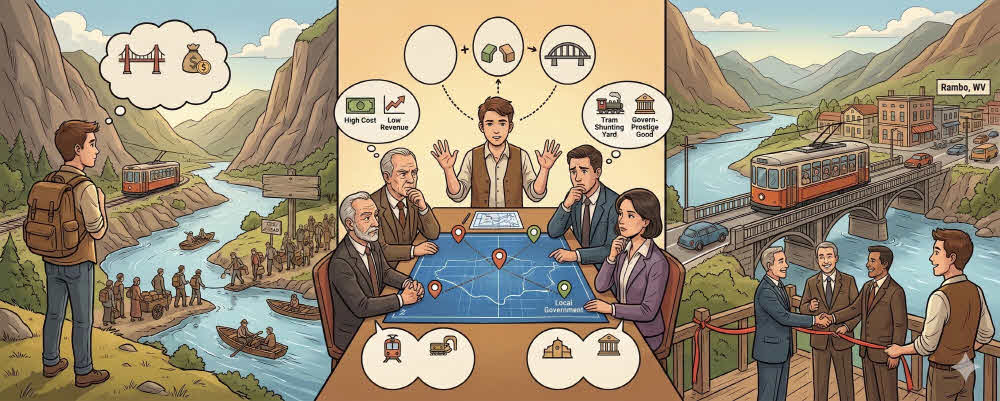
Several years ago, a young American visited a town called Lambeau in West Virginia.
At the entrance to the town, which should have been bustling, he witnessed a strange scene.
The streetcar, a symbol of the town, had come to a halt just 3 kilometers away.
A deep and wide river flowed at the entrance to the town. People had to get off the streetcar and cross the river inconveniently to reach the village.
The streetcar company was not unaware of this problem. However, the cost of building a bridge was astronomical, and from the perspective of a profit-driven corporation, it was nearly impossible to bear such a massive expense alone.
The villagers resigned themselves to the situation, and the streetcar company turned a blind eye.
Thus, the river became a barrier named 'an unsolvable problem,' blocking the village from the world.
But this young man was different. He began to draw a 'map of interests' hidden behind the superficial problem of simply 'being too expensive.'
And he began to discover surprising facts one by one.
The first piece was the railway company.
Coincidentally, the railway company's train shunting facilities were intricately intertwined there; due to the structure intersecting with tunnels, there was always a risk of accidents, and traffic congestion was severe.
If the tram lines were repaired and the roads rerouted, the railway company could solve the persistent safety accidents and operational efficiency issues at once.
The second piece was the local government.
Solving the residents' long-cherished wish was the government's biggest challenge, and the political prestige and trust they would gain by resolving this chronic traffic problem were worth an invaluable amount.
The young man was now convinced. He visited the tram company and made an unconventional proposal.
"Please bear only one-third of the total cost. I will take responsibility for raising the remaining two-thirds."
From the tram company's perspective, there was no reason to refuse. It was the moment when the weight of 100, which he could not possibly bear alone, was reduced to 33.
With this assurance in hand, the young man went straight to the railway company and the local government in turn. He made the same proposal to them as well.
"I intend to build a bridge to solve your headaches. Please contribute exactly one-third of the total cost. The rest is already prepared."
Everyone shouted 'Yes.' In their eyes, it was the best opportunity to solve their biggest concerns with a reasonable investment of just one-third of the total cost.
The result was astonishing. The bridge, which had seemed impossible, was completed in just five months. The streetcar
now ran smoothly across the river into the village, the railway company was freed from the risk of accidents, and the government received praise from the citizens.
The young man changed the world with nothing but the 'wisdom of sharing problems,' without a single penny of his own capital.
The resonance this story gives us is by no means small. In Korean society, we often regard a 'frontal assault' as a virtue.
However, sometimes 'precise deconstruction' exerts a more powerful force than a frontal assault.
The reason we become frustrated is not because the problem is too big, but because we try to solve it all at once.
Only when we break it down into pieces of cost, technology, and administration—like Rambo's bridge—do we begin to see the niches we can exploit.
The key to the young man's success was not altruism, but the 'discovery of the intersection.'
The moment you consider what the other person is itching for and what benefits they will gain when this problem is solved, your burden is shared.The world moves when a request for "help" becomes a proposal to "make a profit together."
We have had beautiful traditions since ancient times known as 'Pumasi' and 'Dure.'
The wisdom of the entire village sharing the burden of rice planting, which is difficult to handle alone, aligns directly with this young man's strategy.Even in the complex business and interpersonal relationships of modern society, this principle of 'mutual growth decomposition' remains a valid answer.