In 1981, the eyes of the world were fixed on London, England.
The 'wedding of the century' between Prince Charles and Diana Spencer looked perfect, like a scene from a fairy tale.
People went wild over every elegant gesture of Diana and every loose thread on her dress.
At that time, when public craving had reached its peak, a very sophisticated and audacious plan was being devised behind a dark alley in London to turn this intense fervor into money.
Today, I would like to tell the story of a 'lie that seemed more real than the truth,' designed by a jeweler.
The jeweler was clever.
He realized that what people wanted to see was not the 'real Diana,' but the 'perfect Diana' existing in their fantasies.
He first scoured all of London to find a model who bore an astonishing resemblance to Diana.
However, a mere resemblance in face was not enough.
He dressed the model in the silk dresses and hats Diana favored, and rigorously trained her to mimic her characteristic shy yet elegant head angle, soft tone of voice,
and even the fleeting habit of smiling at the public. For several months, the model erased her ego and donned the persona of the 'fake Diana.'
The preparations behind the scenes were just like the process of producing a massive blockbuster movie.
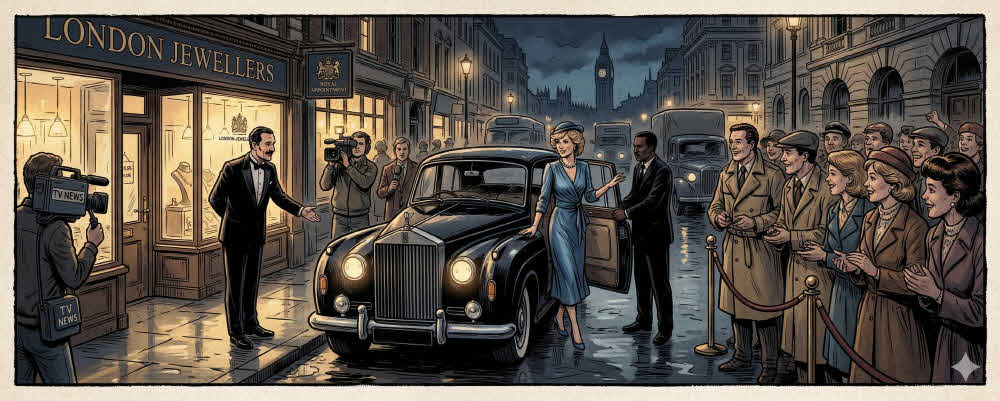
One deepening evening, the jewelry shop emitted dazzling lights brighter than usual.
The owner, dressed in a tuxedo, stood at the entrance with a reverent posture, as if welcoming a member of the British Royal Family. Passersby stopped in their tracks at the strange tension.
Soon, a black luxury sedan glided to a stop, and as the doors opened, everyone held their breath.
The person who stepped out of the car was none other than 'she'. Princess Diana entered the shop elegantly, guided by the jeweler, and smiled with satisfaction as she examined the displayed jewels one by one.
And from the moment she carefully selected a few pieces of jewelry and paid for them, all these scenes were captured intact by TV cameras hired in advance by the owner.
The following evening, this footage filled TV screens across London.
Interestingly, there was no narration in this video.
The jeweler intentionally broadcast the footage like a silent film. "Because there was no explanation, the public filled in the blanks with their own imaginations."
People believed without a doubt that the woman in the video was the real Diana, and they became obsessed with finding out what jewelry she had chosen.After the broadcast aired, the jewelry store was literally packed with people. The 61 pieces of jewelry, rumored to have been highly praised by Diana, became so popular that they were practically impossible to find. Young people in London willingly opened their wallets, driven by a desire to connect with her, even in a small way, or by a yearning to possess her elegance. In just a few days, the jeweler's sales easily surpassed the total he had earned over the past few years. People were happy, believing that the jewelry they bought was 'Diana's choice.' The truth no longer mattered. For the public, the 'ecstatic fantasy' they felt when buying the jewelry had already become the reality. Shadows of Longing: We often do not love the object itself, but consume the 'image' it provides. The jeweler precisely exploited the psychology of vanity and adoration.
The Power of Clever Production:When fact and fiction are mixed, and when combined with public desire, falsehood exerts a power more potent than truth.
Definition of 'Real':If the public all believes it to be real, and actual economic and psychological changes occur as a result, can we continue to call it 'fake'?
Some cloud our judgment with sophisticated fake news, while others win our envy with edited daily lives.
Just as Londoners in the 1980s went wild for the smile of a 'fake Diana' and bought jewelry, could it be that we, too, are lining up to buy an elaborate 'illusion' designed by someone else?
In a world where truth and falsehood are intertwined, the most shining jewels are not a flashy necklace chosen by others, but 'cold reason that sees through the phenomenon' and 'my own standards.'
In a world where the fake becomes the real, what do you believe to be real?