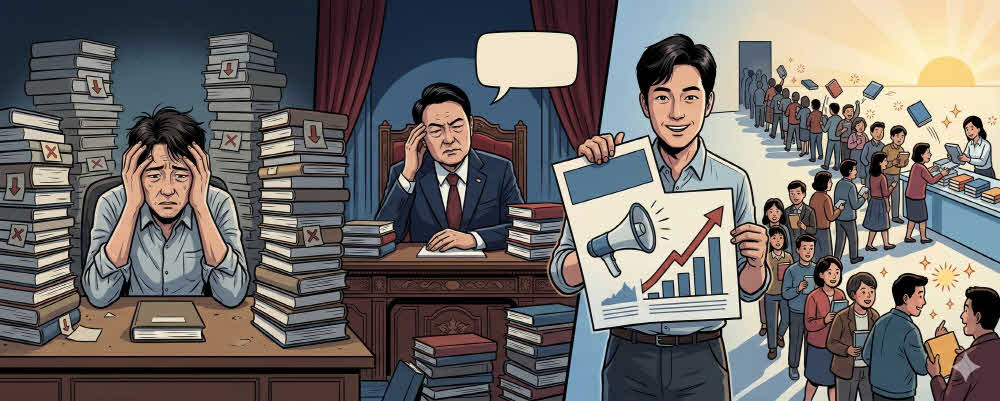
Once upon a time, on a certain street, there was a publishing house that had produced excellent books but was on the brink of bankruptcy due to a lack of promotion.
The warehouse was filled with books gathering dust. Standing at the edge of a cliff, the publisher decided to make a very dangerous and daring gamble.
He decided to make the nation's highest elder, the 'President,' his marketing partner. Of course, the President had absolutely no idea about this.
The publisher carefully packaged a single copy of the unsold book and sent it to the Blue House.
And every few days, he asked the President for his opinion. The President, who was frantically busy with state affairs, wanted to cut off contact with this persistent businessman.
So, he skimmed through it and left a short note saying, "This book is really good."
At that moment, the publisher's eyes lit up. The next day, this advertisement was posted in every newspaper and on the streets.
"The very book highly praised by the President of the Republic of Korea! Meet it right now!"
Since the President said it was good, people rushed to the bookstore one after another. The stock filling the warehouse was gone in an instant.
Some time later, when another book failed to sell, the publisher used the same trick. However, this time, the President was not easily fooled.
Angry at having been used last time, the President decided to play a trick on him this time. "This book is truly terrible! It is not even worth reading."
It was a harsh critique mixed with condemnation. But the businessman did not crumble. Instead, he slapped his knee."A controversial work that the President criticized in anger! Just what on earth is it about? Check it out for yourself!"
People's psychology is peculiar. They are more drawn to what is told 'not to do,' and more curious about what is 'bad.' Driven by the curiosity of "Just how messed up is it for the President to react like that?", the book sold out even faster than the first one.
Now the President realized. He understood that both affirmation and negation would ultimately become prey for that businessman. So, when the third book was delivered, the President kept his mouth tightly shut.
He did not answer any questions, nor did he show any emotion. He believed that 'no response was the best policy.'
However, this publisher was a 'genius.' Upon seeing the President's blank response section, he cheered and put up an advertisement.
"The single book that left the President speechless! Experience the moving emotion that leaves you speechless!"
What was the result? The tagline "a book that leaves you speechless" stimulated people's imaginations, and the book recorded truly legendary sales figures.
To the publisher, the 'situation' did not matter.
Whether the President praised him, cursed at him, or ignored him, he reinterpreted all those 'phenomena' within a 'context' favorable to himself.
We, too, are sometimes frustrated by the world's indifferent reaction.
However, only my interpretation can transform even that indifference into an "unknown mystery."
While traditional advertising lists only 'advantages,' this businessman utilized elements of 'negation' and 'silence.'
A word from an authority figure still carries power, but challenging that authority or seeing an authority figure flustered provides tremendous entertainment for the public.
He essentially knew exactly what the public reacts to.