We often use the word 'pretentiousness' in a negative sense.
This is because it conjures up an image of someone dressing up flashily on the outside without any substance.
However, in the world of business, or in the world of relationships where you must win people's hearts, 'sophisticated pretentiousness' can sometimes be a powerful strategy.
Through the story of Mr. Lee, a businessman who built a clothing market in a quiet suburb, we intend to take an in-depth look at 'how scarcity creates desire.'
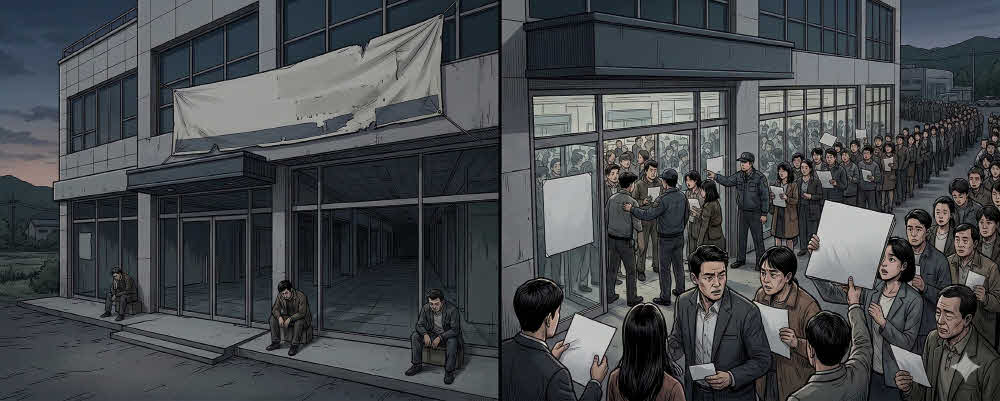
Mr. Lee ambitiously established a two-story wholesale clothing market.
With 150 shops alone. But reality was harsh. The location was not as good as expected, and to make matters worse, a severe recession struck the entire clothing industry.
Despite pouring massive advertising costs into it for fifteen days, only 50 locations were contracted.
The opening day was approaching, but the building remained eerily empty. Mr. Lee was burning with anxiety as he looked at the remaining 100 empty shops.
If the store opened as it was, it was obvious that even the 50 merchants who had already paid their deposits would demand refunds, claiming they had been "scammed." He must have felt like he was standing on the edge of a cliff.
Three days later, a very peculiar notice was published in a local daily newspaper. A typical advertisement would have featured phrases like "massive sale" or "benefit for opening a store now," but the post Mr. Lee released was completely different.
[Urgent Notice] Rental Restrictions Due to Concerns Overheating of Speculation in XX Clothing City
"Recently, inquiries regarding store openings have been skyrocketing. We are particularly concerned as we have detected movements by some customers attempting to secure two or more stores in anticipation of capital gains.
To ensure fairness in the market, we are implementing the 'one store per person' principle starting today. If you wish to acquire two stores under a family member's name, you must present a marriage certificate, and any illegal resale will result in immediate confiscation.
We ask for the mutual vigilance of all citizens.
What happened after this advertisement was released? Industry experts spoke with one voice.
"Even though the location didn't look good, it must have actually been prime real estate. It's no wonder they even asked for a marriage certificate."
The results were surprising. In just one week, the remaining 100 stores were sold out.
People no longer cared about the store's location or rent. The fear of 'Am I the only one missing this train?'—in other words, FOMO syndrome—had kicked in.
This also aligns with the unique consumer psychology of Korean society.
We often see scenes of people doing 'open runs' or standing in long lines in front of popular restaurants.
Some might see this and criticize it as showing off, saying he is "making a fuss," but from a psychological perspective, it is a very instinctive behavior.
Korea has a strong cultural characteristic of placing great importance on the gaze of others and social proof.
The belief that "there must be a reason why everyone else says it is good" overcomes uncertainty. Mr. Lee delved into this very point. He instantly shifted his position from a 'begging seller' to a 'selecting supplier.'
There is much to learn from Mr. Lee's actions, and it would be a mistake to simply dismiss them as 'lies.' He did not simply use deception; he reconstructed the 'frame of value.'
The Law of Scarcity:Human possessiveness is maximized when one feels they cannot have it.
The Granting of Authority:He elevated the quality of the product by using terms such as regulation and crackdown.
Psychological Repulsion:He exploited the contrarian psychology where people want to do something even more when told "Don't do it."
If he had pleaded, "Please come in, I'll give it to you at half price," that market might have remained a ghost building forever.
However, he drew people in through the mask of 'sophisticated pretension,' and eventually, that bustle created the vitality of a real market.
After all, the power to make people believe can sometimes take precedence over 'facts.'
Are you currently selling something or branding yourself? Are you perhaps making yourself too 'common' by saying things like, "Contact me anytime," or "I will do anything for you"?
If you truly want to appear valuable, try drawing a line sometimes, just like Mr. Lee. Sophisticated refusals such as "Only available to [number] people" or "I politely decline [these] types of people" will actually make the other person nod in agreement. This is because people always dream of having a place in a 'hard-to-enter' spot.