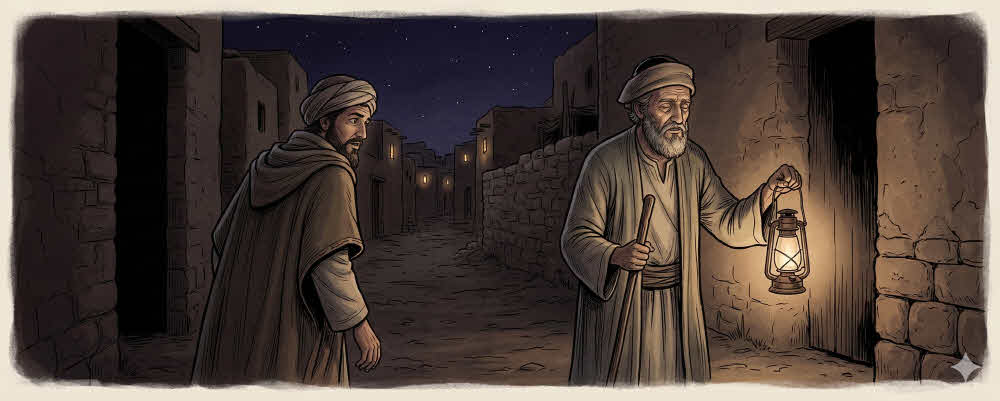
Our contemplation begins with the story of a man walking silently down a village road shrouded in pitch-black darkness one deep night.
He was a visually impaired man who could not see. However, in his hand, he held a lantern that softly illuminated the night air.
A merchant from out of town who happened to be passing by stopped in his tracks out of curiosity.
“Excuse me, old man. Why do you go out of your way to carry a lantern using oil when you cannot see? After all, isn't darkness and light the same to you?”
The merchant’s question was extremely logical, and perhaps resembled the perspective of us modern people who prioritize efficiency.
But the old man simply replied with a gentle smile.
“You are right. This light is of no use to me. However, this lamp is not for me, but for those who can see, like you.
Only when I hold the lamp in the darkness will you discover me and avoid bumping into me. Ultimately, this light is a way to keep you safe and, at the same time, protect me.”
Why does this short fable resonate so deeply in our hearts? It is because it penetrates the 'art of coexistence' that we often live forgetting.
In Korean society, we often regard 'not causing harm to others' as the highest virtue. However, the old man's wisdom goes a step further than that.
By lighting the light first, I do not even give the other person a chance to make a mistake; in other words, it tells us that active consideration becomes perfect self-defense.
For the visually impaired, darkness is not an obstacle. It is simply a familiar part of their daily life. What is truly dangerous is not the darkness itself, but the unexpected situation where someone rushes at them from the darkness without seeing them.The elderly person accurately recognized their limitations and compensated for them by borrowing the gaze of others.
Our lives are not much different from this dark night road. Whether in human relationships, business, or amidst complex social conflicts, we sometimes walk in a 'state of not seeing.'
We must not simply walk in silence just because our hearts ache or because we are in this situation. You must clearly show your boundaries and status like a 'lamp' so that the other person does not misunderstand or hurt you. Accidents usually begin with the phrase "I didn't know." Sharing information first and letting others know your location is an act of kindness toward them, and at the same time, it is the most economical strategy to prevent potential harm at the source. The old man's lamp lit the merchant's path. Thanks to this, the merchant traveled safely, and the old man did not collide with the merchant. It is a virtuous cycle where sharing a little of the resources (kerosene) you possess to help others is ultimately returned to you as peace. The meaning of 'lamp' in Korea is that there is a saying called 'Yeokjisaji' (putting yourself in someone else's shoes). However, this old man's attitude goes beyond mere empathy and is closer to 'preemptive empathy.' The mindset of "I will ensure that the other person is not flustered because of me" is a combination of our people's unique 'Jeong' (affection) and 'Ye' (propriety).
While a lamp illuminates the path, it is wisdom that illuminates the heart. Even if what I possess appears useful to others but useless to me, isn't the willingness to take it out and step forward the true mark of an adult?It is said that the world is becoming increasingly harsh and individualized. Trapped in our own darkness, we are frequently clashing and getting hurt while failing to see one another.At times like these, what we need most is the lamp of the elderly.This simple yet clear truth: "I must shine for you to see me, and only when you see me can I be safe."What kind of lamp are you holding for someone else, and for your most precious self?
Consideration is not a sacrifice, but an investment. The kerosene used by the elderly was not a waste, but a cost for safety.
You need the courage to make your condition known. Silence breeds misunderstanding, and misunderstanding breeds conflict.
In a world where we live together, there is no such thing as 'alone.' I am defined and protected through the eyes of others.
It reminds us once again of the 'responsibility and wisdom of being a visible being' as we live in modern society.
I hope your lamp lights someone's path today, and that warmth once again moistens the back of your hand.