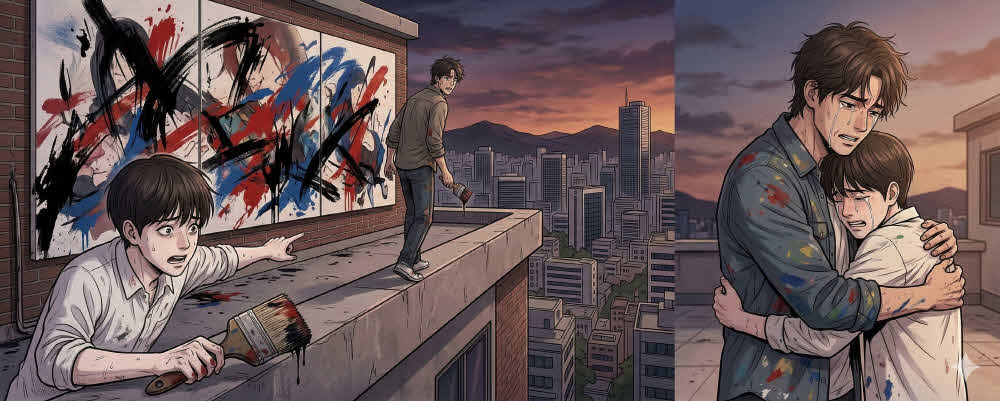
On the rooftop of a high-rise building where the sun beat down stingingly, an artist was completing a massive mural.
It was a work he had devoted himself to for months, forgetting even to eat and sleep.
Finally finishing the last brushstroke, he wiped his sweat and stepped back.
It was because he wanted to take in the masterpiece born from his fingertips in a single glance.
The work was perfect. The texture of the light and the harmony of the colors were enchanting enough to make even the artist marvel.
Smiling with satisfaction, he took another step back.
It seemed it would look even more perfect from a little further away. However, behind the aesthetic ecstasy he was intoxicated by, the shadow of a cold fall loomed.
He stood at the edge of the podium. Just one step. If he took that slender single step further, he was destined to fall dozens of meters down to the concrete floor.
Trapped solely in the world of the 'painting' before his eyes, he was completely oblivious to the reality of the 'cliff' behind him.
The heart of the young assistant watching the scene sank. The assistant, about to shout "No!" or "Stop!", closed his mouth in a split second.
What would happen if he screamed now? The painter, who was in extreme immersion, would be startled by a sudden shout, and there was a high probability that he would lose his balance as a reaction, flinching or stepping backward.
For fear is bound to paralyze rational judgment and destroy physical balance.
Instead of screaming, the assistant chose the most cruel yet brilliant method. He picked up the large brush lying on the floor and roughly hurled the paint at the very center of the mural the painter had cherished so dearly.
And then, like a madman, he painted over the beautiful picture.
The painter was horrified to see the painting, which was like his soul, being miserably destroyed.
Swallowed in rage and shock, he instinctively rushed toward the painting—that is, toward the inside, away from the cliff.
"What are you doing!"
The painter stopped before grabbing the assistant by the scruff of the neck. The assistant had slumped to the floor, his face pale, pointing toward the edge of the podium where the painter had just been standing.
Only then did the painter realize. He realized that the perfect beauty he had just indulged in was leading him to death, and that what the assistant had ruined was not the 'painting,' but the very 'path to death.'
He silently embraced the trembling assistant. This was because while the painter had a painting to repaint, the assistant had a single teacher he could never have again.This story suggests that the 'quick judgment' commonly spoken of in our society does not simply mean being quick at calculations.
We can connect this to the wisdom of 'cutting off flesh to cut off bone.'
The saying "giving up one's own flesh to break the opponent's bones" signifies the resolve to boldly sacrifice what is precious right in front of one's eyes for a greater value.
Koreans are full of "jeong" (affection) and place great importance on relationships. Therefore, when someone goes down the wrong path, people often try to persuade them with words or appeal to their emotions.
However, when the other person is blinded by something (obsession) or is in a state of extreme emotional agitation, a direct approach actually becomes poison.
The Pitfalls of Immersion and the Aesthetics of 'Nunchi' In Korean, 'Nunchi' is sometimes used in a negative sense, but essentially, it refers to "the intelligence to grasp a situation in a three-dimensional way."
The assistant displayed the ultimate 'Nunchi' by simultaneously grasping the master's psychological state and physical location. It is the act of snapping someone back to their senses by striking the very object of their obsession when you know what they are fixated on. This is the communication method of the wise.
The Act of Silence Stronger Than Shouting We believe that raising our voices is the best course of action in moments of crisis.
However, true leaders or helpers use 'shock therapy' to calm the other person's excitement. It is important not to get caught up in the other person's logic, but to dismantle the logic itself and refram the situation.
The Decision to 'Empty' is Harder Than 'Filling' The painter forgot how to empty (look behind) while focusing on filling.
The assistant filled life by emptying (destroying) what was filled. In our lives as well, we often find ourselves standing on the edge of a cliff, immersed in stocks, real estate, careers, or specific relationships, shouting "just one more step."
At this moment, what we need may not be better information or encouragement, but an 'inconvenient truth' that will pull us out, even if it means boldly destroying what we are currently clinging to.
When someone precious to you is lost in a dangerous conviction, what choice would you make?
Would you scream along with them and watch their precarious retreat,
or would you tear up the canvas they are looking at, even if it means facing criticism?
True judgment comes from deciding 'what to stop' rather than 'what to do.'
We must remember that sometimes, tearing down a painstakingly built tower is the only way to save someone standing precariously atop it.
Is someone precious to you perhaps retreating, lost in a picture of dazzling success or deep sorrow?
What is needed then is not your eloquent speech, but
a rough but sincere 'single brushstroke' to bring him into reality.