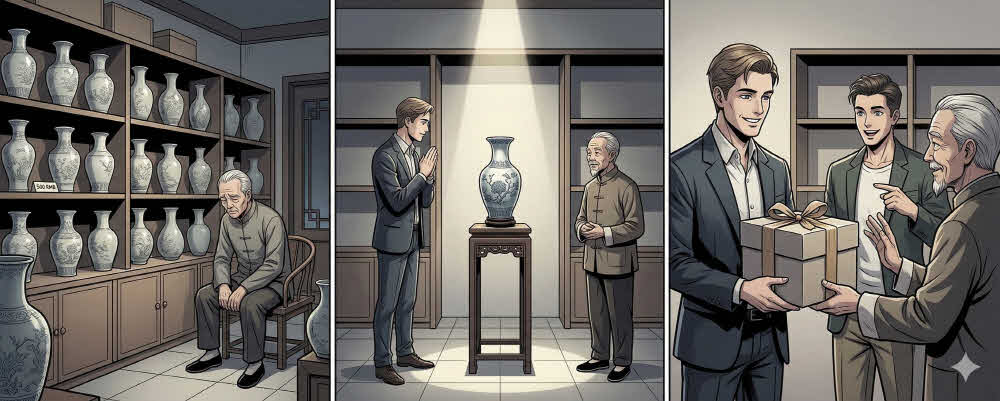
On a quiet street, there was a small shop where items filled with sincerity awaited their owner.
Neatly arranged there were antique ceramic vases imbued with the craftsman's spirit. The price tag bore the honest figure of '50,000 won.'
However, strangely enough, people simply walked past it, and not a single person readily opened their wallet.
Was it because the stacked vases looked like 'common items that could be bought anytime'? Despite being clearly valuable works of art, the sincerity hidden within the abundance reached no one.
Then one day, the shop owner made a momentous decision. He moved all the vases that filled the display shelves into the warehouse and left only a single vase behind.
And he changed the number written below to ‘500,000 won.’ A price that had jumped tenfold, and an empty display shelf. Logically, it was a situation where it shouldn't have sold any more, but something magical began to happen.
A passing customer stopped in his tracks. He was captivated by the noble appearance emanating from the only remaining vase.
He said he liked the vase so much and asked if it would be possible to make a matching pair of identical ones. The owner replied calmly.
"Sir, unfortunately, this vase you are seeing now is the last piece. I will search the workshop thoroughly tomorrow to find one more, but I cannot guarantee it. For now, please take this precious item first."The customer felt a strange shiver at the words "the last one" and happily embraced the vase.The next day, the customer visited the shop again with a fluttering heart. Wiping his sweat, the owner presented another vase, carefully wrapped.
At the owner's words that he had obtained it with difficulty, the customer rejoiced like a child who had discovered treasure. He even brought a friend and earnestly begged if he could get another one of these precious vases.
The owner did not hand over the item immediately. "I will look around again all night. Would you mind stopping by again tomorrow?" he said, sending him away politely. Although it was the inconvenience of having to travel a long distance again, the guest's eyes sparkled with anticipation rather than annoyance. The Principle of Scarcity (Scarcity Effect)
Things that anyone can have are undervalued. On the other hand, the fact that there is 'only one' provides a powerful justification for owning that item.
The mindset that "it has to be now" takes precedence over logical judgment. Details that were invisible when it cost 50,000 won are elevated to artistic value the moment it reaches 500,000 won and the modifier 'last' is attached.
Consumers do not simply buy a product. They purchase the time and wait spent to acquire it—in other words, the 'story'. Feeling a greater attachment to something obtained with difficulty than something easily acquired is close to human instinct.
It is not just ceramic vases.
The same applies to the services and content we provide, and even our own value.
Are we giving the impression that we are too common and always ready?
True value sometimes begins with 'subtraction'.
Controlling supply, taking the time to devote care, and providing 'space for waiting' for customers to fully savor the value.That may be the best technique for creating value that transcends price.The harder something is to obtain, the greater the joy of ownership. And that joy naturally leads to an increase in value—that is, the justification of the price.Whether you keep your value at 50,000 won or turn it into a 500,000 won treasure ultimately depends on 'how you present it and how you make people wait.'