We live amidst tens of thousands of advertisements every day.
But how many of them actually remain in our memories? Here is a peculiar story that is still talked about decades later, navigating the space between marketing 'radicalism' and 'ethics.'
I would like to unravel, in a narration format, the intriguing process of how a woman's desperate cry from beyond a transparent glass wall turned a brand into a legend.
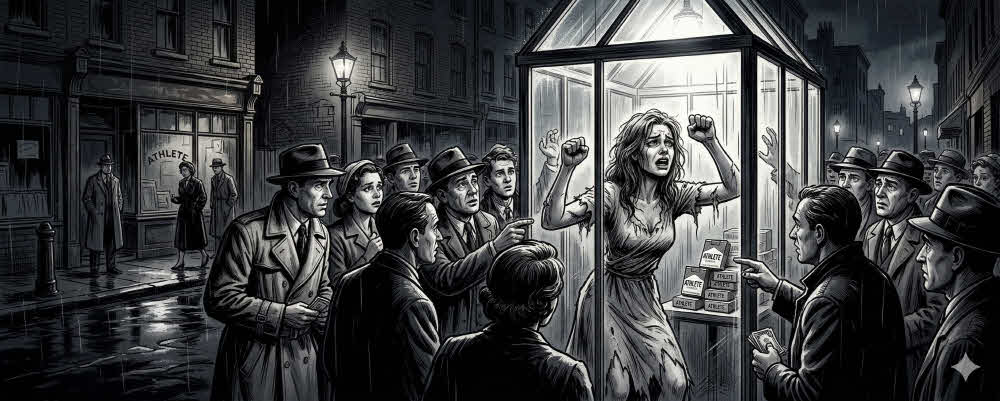
One ordinary afternoon, a peculiar glass greenhouse was erected in front of a shop in the heart of the city.
Inside that narrow, transparent space, a beautiful woman was trapped, looking as if she had just stepped out of a masterpiece painting.
She banged on the glass wall and cried out desperately to the passersby.
"Please help me, I want to get out of here..."
Her voice was clear and pure, but deep sorrow filled it. People stopped one by one.
Some began to surround the glass house out of bewilderment, others out of curiosity, and still others out of sincere concern. The crowd quickly formed a large circle, focusing on her every move.
Wiping away tears in front of the countless eyes watching her, the woman pointed to a product beyond the glass. It was the newly released filter cigarettes of the brand 'Athlete'.
"I can only get out of this prison-like place if all these cigarettes are sold. Please help me."
Her expression was tender, shy, yet desperate. A strange emotion swirled in the hearts of the people.
Pity for the imprisoned beauty and a sense of heroism were stimulated by the fact that they could help someone gain freedom for a very small cost (a pack of cigarettes).
Everyone took money out of their pockets. People willingly opened their wallets not because they wanted to buy cigarettes, but because they wanted to 'rescue' her from the glass house.
This was E.N. of Edmonton, Canada. It was the beginning of a groundbreaking 'psychological marketing' scheme planned by a tobacco company, something unimaginable at the time.
The marketing did not stop there. She lived inside that glass day and night.
The silhouette of her eating, sleeping, and even changing clothes was faintly visible through the glass.
People lingered around the area late into the night as if under a spell.
She became an object of romantic longing for some and a captivating object of observation for others. The results were astonishing.
1 million packs of cigarettes sold out in just 130 hours. 'Athlete', a fledgling brand, instantly shook up the market and rose to the ranks of bestsellers.
Instead of simply shouting "Our cigarettes are of high quality," they incorporated a narrative of "Please save the woman." Consumers were buying a 'story', not a product.
The people surrounding the glass house became a community sharing the same emotions. It can also be seen as the origin of the modern SNS 'challenge' or 'pop-up store' craze.
It stands out for its sophisticated psychological design that maximizes people's curiosity while ensuring it leads to 'interest' and 'compassion' rather than discomfort.
Defamiliarization: Like an unfamiliar scene encountered on a familiar street, fresh visual stimuli that disrupt the customer's daily life are required.
Participatory Value: You must give customers the feeling that they are not merely onlookers, but are solving a situation or contributing to value through their purchase.
Emotional Connection: Powerful more than rational explanation is fleeting emotion and It is a sense of connection. Launching a new brand into the world is like erecting a transparent glass wall amidst countless competitors. What to fill it with is entirely up to the planner. Will it be nothing more than a sensational show, or will it contain an authentic narrative that moves people's hearts? This ingenious yet chilling marketing case from the past tells us: that winning the market's heart is ultimately not about 'product specifications,' but about 'ideas that move people's hearts.'